A practical framework for defining scope, assigning responsibility, setting service frequency and holding a commercial kitchen cleaning partner accountable across corporate cafeterias, hotels, food halls, institutional dining operations and industrial kitchens.
What should a commercial kitchen cleaning checklist include?
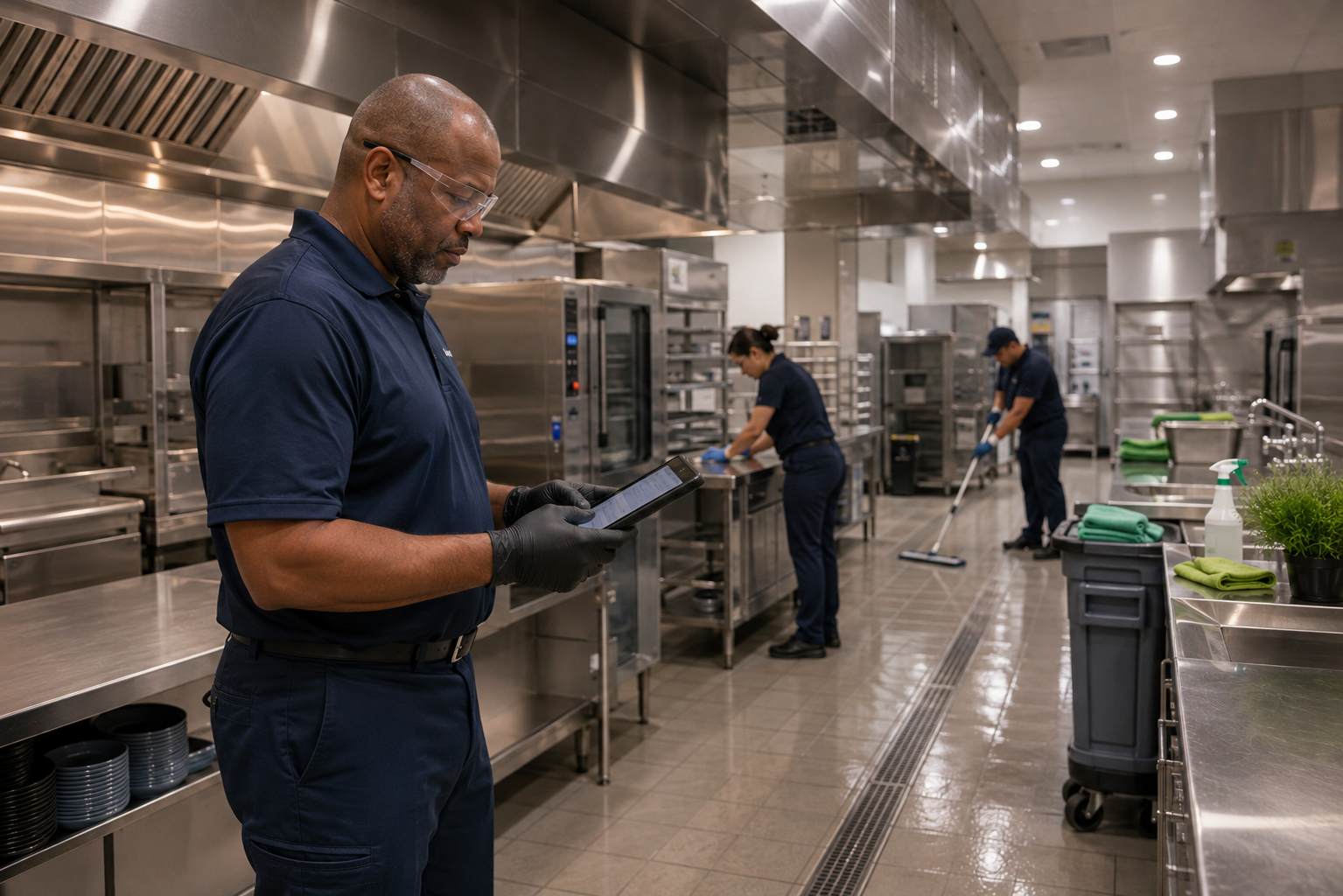
A commercial kitchen cleaning checklist should identify every included zone, the responsible party, required frequency, approved method, access window, verification step and specialty exclusion. For large facilities, the checklist must cover more than the cook line. It should coordinate kitchen floors, accessible equipment exteriors, service counters, dining areas, waste zones, loading transitions, restrooms and support corridors without confusing facility cleaning with food-production sanitation or specialist exhaust work.
The strongest checklist is not a generic list downloaded from the internet. It is a controlled service document built during a facility walkthrough and connected to the site's food-safety plan, equipment requirements, operating schedule and quality-assurance process.
Facility managers usually discover weaknesses in a kitchen-cleaning contract after the program begins. Grease remains beneath movable equipment. The vendor assumes the kitchen staff owns the service corridor. The kitchen staff assumes the vendor cleans the waste staging area. A floor machine arrives during receiving. A specialty system is excluded, but nobody documented the exclusion. Each problem comes from the same root cause: the scope described tasks without defining operational ownership.
This guide is designed for the people who must prevent those gaps—facility directors, property managers, procurement teams, hospitality operators and institutional food-service leaders. It complements Cleanstar National's commercial kitchen cleaning services for high-volume facilities by showing what should be settled before a crew mobilizes.
Why do generic kitchen-cleaning checklists fail in large facilities?
A small restaurant, hospital cafeteria, university dining hall, convention hotel and centralized production kitchen do not share the same traffic, equipment, access or risk profile. A universal checklist may name familiar surfaces, but it cannot establish who moves equipment, which chemistry is compatible, when a zone becomes available or how a missed task is escalated.
The scope stops at visible surfaces
Floors can look acceptable from the aisle while buildup remains along edges, around casters, beneath accessible equipment and at the transition between cooking and service zones. A checklist must identify these locations explicitly.
Responsibility is implied instead of assigned
Food-contact sanitation, general facility cleaning and specialty mechanical services may belong to different teams. If the document uses phrases such as “complete kitchen cleaning” without a responsibility matrix, disputes are likely.
Frequency is separated from operating reality
A task scheduled “weekly” is still undefined until the contract identifies the day, access window, production shutdown requirement, equipment movement and person authorized to release the area.
Completion is measured by appearance alone
“Looks clean” is not a consistent service standard. Large programs need defined inspection points, exception reporting, corrective-action ownership and a record showing what was completed.
The commercial kitchen cleaning scope checklist
Start with zones rather than isolated tasks. Zoning makes it easier to coordinate access, tools, chemistry and cross-contamination controls. During the walkthrough, mark each item as included, excluded, facility-owned, food-service-team-owned or assigned to a specialist.
1. Production and cook-line perimeter
- Floors, grout lines, edges, corners and accessible drains
- Accessible walls, baseboards, splash zones and ledges
- Equipment exteriors, legs, casters and surrounding floor area
- Accessible spaces beneath or behind equipment approved for movement
- Door fronts, handles and other agreed non-food-contact touchpoints
Document who disconnects, unlocks or moves equipment. A cleaning crew should never infer authorization to move powered, plumbed, hot or production-critical equipment.
2. Preparation and service areas
- Non-food-contact counter exteriors and accessible cabinet fronts
- Service-line exterior surfaces, sneeze-guard exteriors and queue rails
- Floor transitions between preparation, service and dining zones
- Walls, baseboards, doors and high-touch non-food-contact surfaces
- Closing-condition reset requirements for the next operating period
Food-contact surfaces require separate procedures aligned with the facility's food-safety plan. Do not bury that responsibility inside a broad janitorial description.
3. Warewashing and utility zones
- Floors, walls, baseboards and accessible splash areas
- Exterior surfaces of warewashing equipment
- Floor sinks and accessible drains when included
- Chemical-storage-area housekeeping and spill reporting
- Mat handling, drying and replacement responsibilities
These zones combine water, soil, chemical products and constant traffic. The scope should specify slip-control practices, caution signage and who addresses active leaks or maintenance conditions.
4. Dining and guest-facing spaces
- Dining floors, carpet, baseboards and accessible wall surfaces
- Tables, chairs, booths and shared non-food-contact touchpoints
- Beverage-station exteriors and waste stations
- Entrances, glazing, queue areas and public corridors
- Restrooms, dispensers, fixtures and replenishment responsibilities
Facilities that remain active throughout the day may also need commercial day porter services for spill response, waste monitoring and live-area presentation.
5. Waste, loading and back-of-house routes
- Interior waste stations and container exteriors
- Service corridors and transitions to receiving or loading areas
- Dumpster-enclosure or loading-dock scope when specifically included
- Spill-response ownership and escalation
- Traffic sequencing around deliveries and waste removal
Waste routes are frequently omitted because they sit between departments. Map the entire path from kitchen collection point to the agreed facility boundary.
6. Floors and asset-preservation tasks
- Surface type and manufacturer restrictions
- Daily cleaning versus periodic machine-supported care
- Degreasing boundaries and compatible chemistry
- Grout, edge and transition-zone expectations
- Drying, reopening and slip-control requirements
Large kitchens often connect to broader flooring programs. Coordinate the checklist with commercial floor care instead of treating every surface with the same method.
How often should a large commercial kitchen be cleaned?
There is no responsible universal answer. Frequency depends on food flow, production volume, surface type, soil load, operating hours, local requirements, equipment instructions and the facility's food-safety plan. The FDA Food Code establishes specific expectations for food-contact surfaces and also states that non-food-contact equipment surfaces should remain free of accumulated dust, dirt, food residue and debris. Your facility should use those requirements—and the rules adopted by its jurisdiction—as a baseline, not substitute a vendor's marketing checklist for regulatory review.
Authoritative reference: FDA 2022 Food Code, Chapter 4.
| Planning interval | Typical focus | Questions to settle | Verification |
|---|---|---|---|
| During operations or each shift | Food-contact procedures, spills, active waste, touchpoints and immediate hazards | Which tasks belong to trained food-service staff, sanitation staff or a day porter? | Shift log, manager check and exception escalation |
| Daily closing window | Floors, accessible exterior surfaces, service areas, dining spaces, restrooms and waste zones | When is each zone released, and what must remain untouched for production? | Checklist completion and supervisor review |
| Weekly or scheduled periodic cycle | Edges, casters, accessible under-equipment areas, walls, baseboards and detailed floor work | Who moves equipment, controls utilities and authorizes access? | Defined inspection points and corrective action |
| Monthly, quarterly or project-based | Deep-cleaning zones, floor restoration, high-detail work and operational resets | Does the task require shutdown, specialist service or additional safety planning? | Pre/post condition review and closeout record |
This matrix is a scoping framework, not a regulatory cleaning schedule. The person in charge should align final frequencies with applicable food codes, the facility's HACCP or food-safety program, product labels, equipment instructions and local health authority requirements.
Cleaning, sanitizing and disinfecting are not interchangeable
Cleaning removes soil and organic material. Sanitizing reduces microorganisms on a cleaned surface to an acceptable level under the applicable process. Disinfecting uses a product and method intended to kill specified microorganisms on appropriate surfaces. In food-service environments, the correct sequence, product, concentration, contact time, rinsing requirement and surface compatibility matter.
The FDA has reported that a complete wash-rinse-sanitize-air-dry process was effective for removing allergens and minimizing transfer in its retail food establishment study. The same research found that material, texture, soil type and wipe condition affected results. That is why a scope should never reduce controlled food-contact sanitation to the phrase “wipe all counters.”
Source: FDA research on allergen removal and cleaning methods.
Chemical control also belongs in the plan. OSHA's Hazard Communication Standard addresses labels, safety data sheets, employee information and training for hazardous chemicals in the workplace. Before service begins, confirm who approves products, where current SDS information is available, how secondary containers are labeled and which products are restricted around food, equipment or sensitive finishes.
Which exclusions must be written into the kitchen-cleaning scope?
Exclusions protect the facility as much as the vendor. They prevent unqualified work, unsafe assumptions and budget surprises. Each exclusion should name the responsible party or state that a separate specialist proposal is required.
- Internal hood, duct and exhaust-system cleaning
- Fire-suppression components and inspections
- Grease traps, interceptors and regulated waste handling
- Internal sanitation of food-production machinery
- Disassembly or servicing of powered, heated or plumbed equipment
- Pest-control treatment and structural remediation
- Biohazard, sewage, mold or hazardous-material response
- Work above the agreed height or requiring specialty access equipment
- Repairs, maintenance and correction of active leaks or damaged surfaces
If a task requires a licensed trade, fire-protection contractor, hazardous-material provider or another specialist, keep it outside the general cleaning scope until qualifications, insurance, access and closeout requirements are confirmed. “Not included” is safer than an ambiguous promise.
What should facility managers require from a cleaning vendor?
A polished proposal is not proof that the operating program will work. Procurement teams should evaluate how the vendor converts the walkthrough into staffing, supervision, documentation and corrective action. These questions expose the difference between a task list and an accountable facility program.
- Scope ownership: Who writes the final zone map, and how are changes approved?
- Staffing: How is crew size connected to square footage, soil load and the available service window?
- Supervision: Who is the named site lead, and who has authority to resolve exceptions?
- Training: What training is required for chemicals, equipment, PPE, facility access and site-specific restrictions?
- Product control: Who approves chemistry, maintains SDS access and confirms surface compatibility?
- Equipment movement: Which items may be moved, by whom and under what lockout or utility-control procedure?
- Quality assurance: Which locations are inspected, how often and against what defined standard?
- Corrective action: What happens when a task is missed, blocked or rejected?
- Communication: How are spills, leaks, damage, pest evidence or unsafe conditions reported?
- Continuity: What is the backup plan for absences, special events, seasonal peaks or delayed access?
For a deeper procurement comparison, read Enterprise Janitorial Services vs. Standard Cleaning Contracts. Large food-service facilities often need the staffing depth and escalation structure of an enterprise program rather than a loosely managed recurring visit.
How do you implement the checklist without disrupting operations?
Implementation should begin with a joint walkthrough involving facility management, food-service leadership and the proposed cleaning partner. Walk the building in the same order that food, employees, guests, waste and deliveries move through it. Photograph or map boundaries, confirm restrictions and record who can release each zone.
Step 1: Establish the baseline
Document current conditions before service begins. Separate accumulated legacy conditions from the maintainable recurring scope. If the kitchen requires an initial reset, price and schedule that work independently so the recurring standard begins from an agreed baseline.
Step 2: Build the responsibility matrix
Place every zone and task under one owner: food-service team, facility team, janitorial partner or specialty contractor. If two teams share a zone, identify the trigger that transfers control. For example, the kitchen team may complete food-contact sanitation before releasing the floor and equipment perimeter to the cleaning crew.
Step 3: Pilot the sequence
Test the scope during real operating conditions. Measure when zones become available, how long soil removal actually takes, whether equipment can be accessed and whether drying time conflicts with reopening. Adjust the written plan before treating the first estimate as a permanent operating model.
Step 4: Inspect outcomes and exceptions
Review representative high-risk or high-visibility points instead of relying on a vague final walk. Track repeated access blocks, heavy-soil locations and maintenance defects. When the same exception recurs, change the scope, timing or facility condition rather than repeatedly asking the crew to “pay more attention.”
Facilities that combine production kitchens with warehouses, commissary storage or large loading areas may also need an integrated industrial and warehouse cleaning program. Aligning these scopes reduces gaps at the boundary between food service and the wider operating facility.
Related Cleanstar planning resources
Commercial kitchen cleaning checklist FAQs
What is normally included in commercial kitchen cleaning?
A site-specific program may include floors, walls, baseboards, accessible equipment exteriors, service counters, dining areas, waste zones, restrooms and support corridors. The final scope should distinguish general facility cleaning from food-contact sanitation, equipment servicing and specialty exhaust or grease-management work.
How often should a commercial kitchen receive deep cleaning?
The appropriate interval depends on production volume, soil load, surface type, operating hours, applicable food codes, equipment instructions and the facility's food-safety plan. Many facilities combine daily maintenance with scheduled detailed cycles, but the final frequency should be established during a walkthrough rather than copied from a generic schedule.
Is commercial kitchen cleaning the same as food-contact sanitation?
No. Commercial kitchen cleaning can address the broader operating environment, while food-contact sanitation follows controlled procedures for surfaces and equipment that directly contact food. The contract should identify which trained team owns each process and how the zone is transferred between teams.
Are hood ducts and grease traps automatically included?
They should not be assumed. Internal exhaust systems, fire-suppression components, grease traps and interceptors commonly require separate scope confirmation and may require qualified specialty providers. List each item as included, excluded or separately quoted.
Can cleaning be completed after the kitchen closes?
Yes, when the facility provides an adequate release and access window. The plan should account for cooling equipment, closing sanitation, deliveries, security procedures, equipment movement, drying time and the next production start.
What documentation should a cleaning vendor provide?
At minimum, request a written scope, zone and frequency matrix, exclusions, approved product process, access requirements, inspection method, escalation contacts and corrective-action procedure. The exact reporting format should match the facility's procurement and quality-management expectations.
What information is needed for a kitchen-cleaning estimate?
The provider will typically need the facility type, square footage, number of kitchen and dining zones, operating schedule, available service window, current conditions, desired frequency, equipment-access rules, floor types, specialty exclusions and security or onboarding requirements.