Enterprise Janitorial Services vs Standard Contracts | Cleanstar
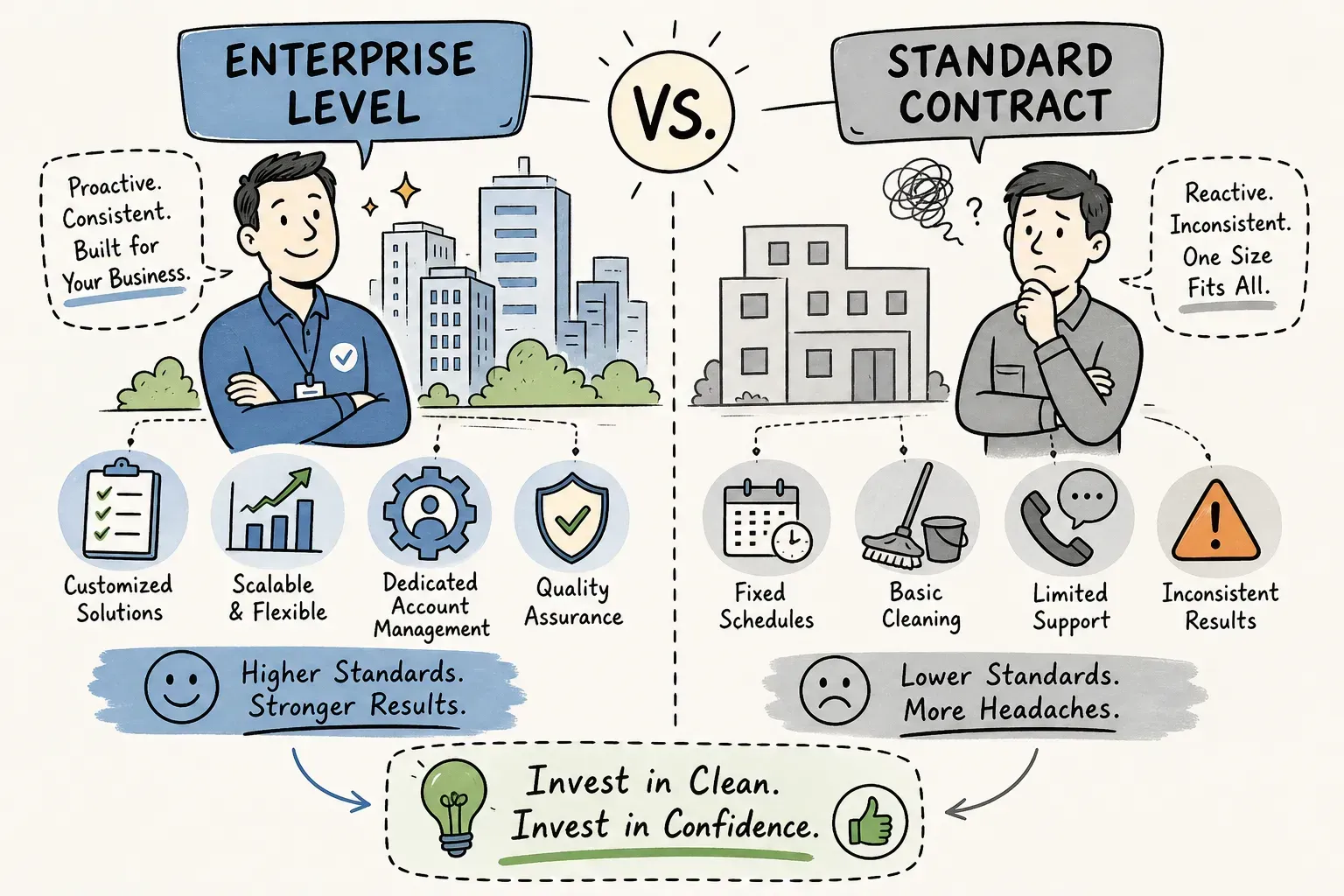
Most facility managers treat enterprise janitorial services like a utility. You pick a vendor, negotiate a price, and assume the work gets done. That assumption is expensive. The gap between a standard cleaning vendor and a true enterprise-grade janitorial provider shows up exactly when it matters: a biohazard spill at 2 a.m., a health inspection your current vendor's paperwork can't support, or a Monday morning where half the crew called out and nobody told you until the trash overflowed in the lobby. These aren't hypothetical edge cases, they're the scenarios that reveal whether your cleaning contract is actually a facility partnership or just a recurring invoice.
Cleanstar National Inc has operated in the Greater Atlanta market since 1995. The company reports more than 700 E-Verified, background-checked employees, photo-verified service checklists, and 24/7 emergency response teams deployed across corporate campuses, healthcare facilities, and educational institutions throughout the city. That's not a cleaning crew. That's a facility partner. This article breaks down exactly what separates that category of vendor from the rest and gives you the tools to find one.
What Actually Defines Enterprise-Grade Commercial Janitorial Services
The word "enterprise" gets overused, but in the janitorial context it has a specific operational meaning. An enterprise janitorial provider isn't just a large cleaning company. It's one built to absorb workforce turnover without degrading service, scale staffing for surge demands, and deploy backup teams without asking the client to accept a lighter service day. That requires dedicated site supervisors, regional management layers, documented staffing models, and the bench depth to cover a 100,000 sq. ft. facility on short notice.
The more important distinction is the operating model. Standard cleaning vendors complete tasks on a checklist. Enterprise vendors take ownership of a facility's hygiene outcomes. That means proactive communication when something is off, facility-specific protocols documented and followed rather than improvised, compliance records available on demand, and accountability structures with real teeth. Facility maintenance and custodial services at the enterprise level are defined by documentation and ownership, not just execution. If your current vendor can't hand you a service report with timestamps and photographic evidence, you're working with the wrong category of provider.
Why Workforce Vetting Sets Enterprise Cleaning Vendors Apart
E-Verification is a federal system that confirms a new hire's legal work authorization by cross-referencing Form I-9 data with government records. For facility managers overseeing corporate campuses, healthcare environments, or schools, this matters because unvetted personnel on your floors are a liability, not just an HR issue. E-Verified hiring combined with background screening is the baseline most commercial janitorial services providers working in security-sensitive environments should meet, and in many cases, it's required by federal contract terms or state law.
Here's the benchmark question to ask every vendor you're evaluating: How many employees do you have, what's your vetting process, and what's your turnover rate? A very small janitorial contractor with no documented screening process will struggle to staff a large facility consistently, especially when turnover hits. A provider with 700+ vetted employees brings coverage depth and staffing continuity that smaller regional operations typically cannot match. That workforce size also signals something about accountability: a company that has invested in building and vetting a team of that scale has infrastructure worth protecting. You'll get a corrective-action process and a real escalation contact, not a disconnected voicemail when something goes wrong.
Enterprise Janitorial Services: Compliance Certifications That Separate Serious Vendors
Most vendors claim compliance. Few can document it. OSHA's standards for janitorial operations span multiple regulations: 29 CFR 1910.1200 covers Hazard Communication and chemical training; 29 CFR 1910.1030 governs bloodborne pathogen exposure procedures; 29 CFR 1910 Subpart I defines PPE requirements; and 29 CFR 1910.22 addresses slip and fall hazard management. When you're evaluating commercial disinfecting services for your facility, ask for training records, SDS documentation for every chemical in use, and written PPE protocols. If a vendor hesitates on any of those, that's your answer.
Required Certifications for High-Risk Environments
Beyond OSHA basics, high-risk environments require specialized training. Bloodborne pathogen certifications, such as those offered through the National Safety Council or aligned with OSHA's bloodborne pathogens standard, and infection-control training programs are not niche credentials. They are the threshold between a qualified vendor and a liability risk for any facility with a medical suite, laboratory, or school health room. If your building includes any healthcare-adjacent space, those certifications are required, not optional. A vendor without them isn't equipped to service those areas safely, regardless of how competitive their pricing looks.
Training Records and SDS Documentation
Certifications alone don't close the gap. The documentation behind them does. Ask for written training logs, current Safety Data Sheets for every product in use, and evidence that employees have completed required annual refreshers. If a vendor can produce those records on request, you have a vendor who understands compliance as an operational discipline, not a checkbox they fill out during the sales process.
Reporting Transparency and SLA Guarantees: What Good Actually Looks Like
Standard vendors tell you the work was done. Enterprise vendors show you. Photo-verified checklist systems work by turning each cleaning task into a mobile workflow: the technician completes the task, uploads before-and-after photos, and the system logs the submission with a timestamp, location, and user ID. Supervisors review and approve. If something fails, a corrective action gets triggered and tracked to closure. That creates an auditable service record you can use in compliance reviews, tenant disputes, and vendor performance discussions.
Every janitorial SLA worth signing must define five things:
- Scope of work, exactly what gets cleaned, how often, and to what standard
- Service frequency, daily, weekly, and periodic task schedules in writing
- Performance metrics, inspection pass rate (target 90% or above), on-time task completion (100%), and emergency response time (under two hours)
- Escalation procedures, who you call, in what order, and within what timeframe
- Remedies for missed standards, corrective action plans, free return visits for any failed standard, and termination rights for repeated failures
If a vendor won't put remedies in writing, they're not confident in their own performance. Don't sign a contract without them. Contract lengths for enterprise accounts typically run one to three years; always negotiate a 30-day convenience termination clause so you're not locked into a vendor that isn't delivering.
What Enterprise Janitorial Services Actually Cost in 2026
Pricing for janitorial contractors varies by facility type, cleaning frequency, and scope. For 2026, the commercial cleaning costs in 2026 planning ranges break down roughly as follows. Office spaces running recurring service typically fall between $0.08 and $0.20 per square foot. Warehouses cluster in the $0.05 to $0.25 range depending on whether the scope involves basic sweeping or heavier-duty degreasing and dust control.
Medical facilities command $0.20 to $0.40 per square foot for standard infection-control protocols, and specialized lab or cleanroom-adjacent spaces can push $0.60 or higher. On an hourly basis, office cleaning contractors generally run $25 to $50 per cleaner-hour for general commercial work, while medical-grade disinfection services can reach $90 per hour or above.
The lowest bid almost never reflects the true cost. Once you factor in add-ons, compliance gaps, and re-cleans after failed inspections, cheap vendors get expensive fast. Enterprise janitorial contracts typically cover daily cleaning tasks, restroom sanitation, trash removal, and surface disinfection as core scope. Common add-ons include:
- Periodic deep cleaning
- Floor care (stripping, waxing, polishing)
- Carpet treatment
- Consumable supply management
- Day porter service
- Post-construction cleanup
Price each of these separately during contract negotiations, and make sure your SLA specifies exactly what's included at the base rate versus what triggers additional billing.
How to Evaluate and Pilot an Enterprise Janitorial Provider
Before you shortlist vendors, run them through a set of questions that reveal operational reality rather than sales capability. The ones that matter most:
- How do you handle backup coverage when a crew member calls out?
- What does your quality assurance documentation look like, and will we see it regularly?
- Who is our day-to-day point of contact, and what is the escalation path for urgent issues?
- Can you provide references from facilities similar to ours in size and type?
- What is your E-Verification and background-check process?
- How quickly can you respond to an after-hours emergency?
These aren't trick questions. They're the filter that separates polished presentations from operationally sound providers.
The Six-Week Pilot Framework
Once you've shortlisted two or three vendors, run a structured pilot before signing a long-term contract. The framework is straightforward:
- Week 1: Contract finalization and site walk scheduling
- Week 2: Joint walkthrough with baseline documentation, square footage, high-traffic zones, access points, special areas, and photographic baseline conditions
- Week 3: Initial deep clean followed by a post-clean audit
- Weeks 4, 5: Routine service with active performance monitoring
- Week 6: Formal KPI review and sign-off decision
The KPIs to track during the pilot: 90% or higher inspection pass rate, 100% on-time task completion, response time under two hours for urgent requests, and a client satisfaction score of 4.5 out of 5 or higher. If a vendor can't hit those benchmarks during a structured six-week pilot with full visibility, they won't hit them in a two-year contract with less scrutiny. The pilot is your insurance policy before you commit.
The Standard Worth Measuring Everyone Else Against
Enterprise janitorial services aren't a bigger version of a standard cleaning contract. They're a different category of vendor built around compliance, documentation, accountability, and workforce depth. Your job as a facility manager or procurement lead isn't to find the cheapest quote. It's to find the provider whose operational infrastructure matches the demands of your facility.
Use the evaluation questions above, run the RFP process, require the certifications, and pilot before committing. For Atlanta-area facilities, Cleanstar National Inc brings 30 years of local operating experience, 700+ E-Verified employees, protocols aligned with OSHA and CDC guidance, and a quality assurance system built around photo-verified accountability. Request a free on-site estimate and see how your current vendor's documentation, workforce depth, and response capabilities compare.
Cleanstar National: Expert B2B Cleaning Solutions for Atlanta's Critical Industries