The Ultimate Guide to Commercial Cleaning in Atlanta

Atlanta has no shortage of companies calling themselves commercial cleaning experts. Most look identical on paper until something goes wrong. As the owner of Cleanstar National Inc, a commercial janitorial services company that has served hundreds of Atlanta businesses since 1995, I've seen what separates a genuine facility partner from a vendor who disappears after the first complaint. This guide covers the five things you should evaluate before signing any commercial cleaning contract in Atlanta, GA: compliance, staffing, service scope, pricing, and quality accountability. Work through each one and you'll have everything you need to shortlist the right provider, ask the right questions, and avoid the most common hiring mistakes.
None of this is complicated. But skipping any of these five areas is how Atlanta businesses end up locked into bad contracts, stuck with inconsistent crews, or dealing with a liability claim they didn't see coming. Take the time to do it right upfront.
1. The baseline requirements every Atlanta cleaning company must meet
Some cleaning companies operate without complete documentation, a problem that often surfaces only after a liability claim. Before you get to service quality, scope, or price, verify that the company can meet the legal and compliance floor.
Business registration and insurance minimums
Any company cleaning commercial facilities in Atlanta must hold a current City of Atlanta Occupational Tax Certificate. This is the city's local business license. It's non-transferable, and renewal is annual. Beyond that, require proof of commercial general liability insurance and workers' compensation coverage before any crew sets foot in your building. For high-risk environments like medical offices, data centers, or corporate campuses with sensitive access, ask for higher liability limits and request to be named as an additional insured on the policy. Verbal assurances aren't documentation. For a clear overview of licensing and insurance requirements specific to Georgia cleaners, review Georgia cleaning business license and insurance requirements.
OSHA and CDC alignment: what it actually means
Some vendors use the phrase "OSHA-compliant" without the documentation to back it up. In practice, OSHA compliance for a janitorial crew means documented training in hazard communication, chemical safety (including updated Safety Data Sheet access for every product used), PPE usage, and fall prevention. According to OSHA's 2024 Hazard Communication Standard final rule, the employer compliance deadline for substance classification and labeling is November 20, 2026, companies that haven't updated their programs are already behind. If a vendor can't produce training records on request, they're not actually compliant. They just say they are.
When bloodborne pathogen and EPA certifications matter
If your facility is a medical office, healthcare clinic, or any environment where staff may contact blood or other potentially infectious materials, bloodborne pathogen training is an OSHA requirement for that cleaning crew, not optional. Require proof that training was completed at initial assignment and annually after that. Pair this with a requirement for EPA-registered disinfectants: that phrase means the products are proven effective against specified pathogens, not just marketed as "hospital-grade."
2. Who's actually walking through your building
A company can have all the right certifications on paper and still send unvetted people into your facility. Staffing practices are where most commercial cleaners differ most significantly, and it's the area prospects rarely think to ask about.
E-Verify and background screening: the real trust layer
E-Verify is a federal system that checks a new hire's I-9 information against SSA and DHS records to confirm work authorization. It's not a replacement for a background check, but it confirms that the person hired is who they say they are on paper. Contrast that with companies that rely on self-reported information and informal reference checks. For schools, medical offices, and corporate campuses with building access requirements, this isn't optional. A company operating at enterprise scale with structured HR infrastructure runs formal background checks as standard procedure. Smaller vendors often don't have that infrastructure at all. For guidance on E-Verify requirements and practical tools for small businesses, see E-Verify for small businesses.
Crew stability and who supervises the work
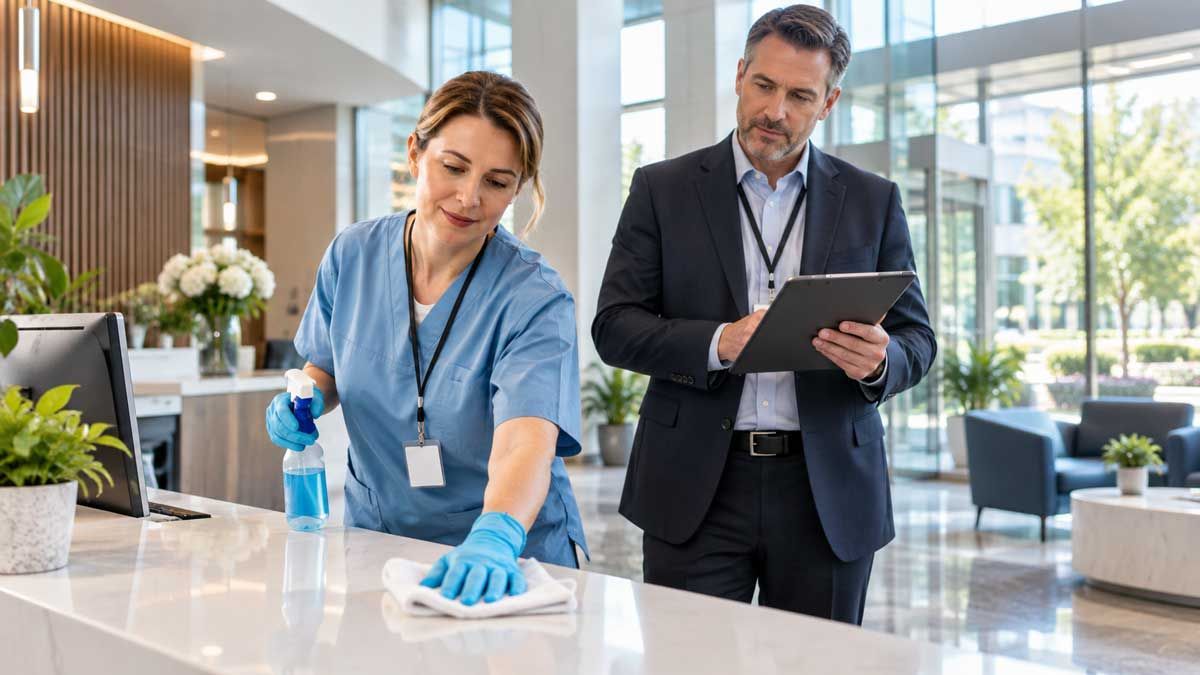
High crew turnover costs you in two ways: retraining time and security exposure. Every new person in your building is a new unknown. Ask specifically whether the same team will service your account long-term, who the on-site supervisor is, and how check-ins are documented. Strong supervision means assigned teams, named leads, and documented completion, not a rotating cast of unfamiliar faces.
3. Matching the service scope to your facility type
Not every cleaning company can handle every building. The scope of industrial cleaning in Atlanta versus a corporate office versus a post-construction site requires different training, equipment, and protocols. Choosing a company without vertical-specific experience is a common and costly mistake.
Medical and healthcare facilities: the strictest standard
Medical office cleaning in Atlanta, GA requires aseptic technique, basic microbiology awareness, proper PPE usage, and strict cross-contamination protocols. A general janitorial company is not equipped for this environment without specialized training. The standard for healthcare-adjacent facilities is higher than office cleaning in every dimension, from the products used to the sequencing of tasks to the documentation required. If your facility is patient-facing, verify that the vendor has specific healthcare cleaning experience, not just a checkbox on their website.
Industrial, educational, and corporate environments
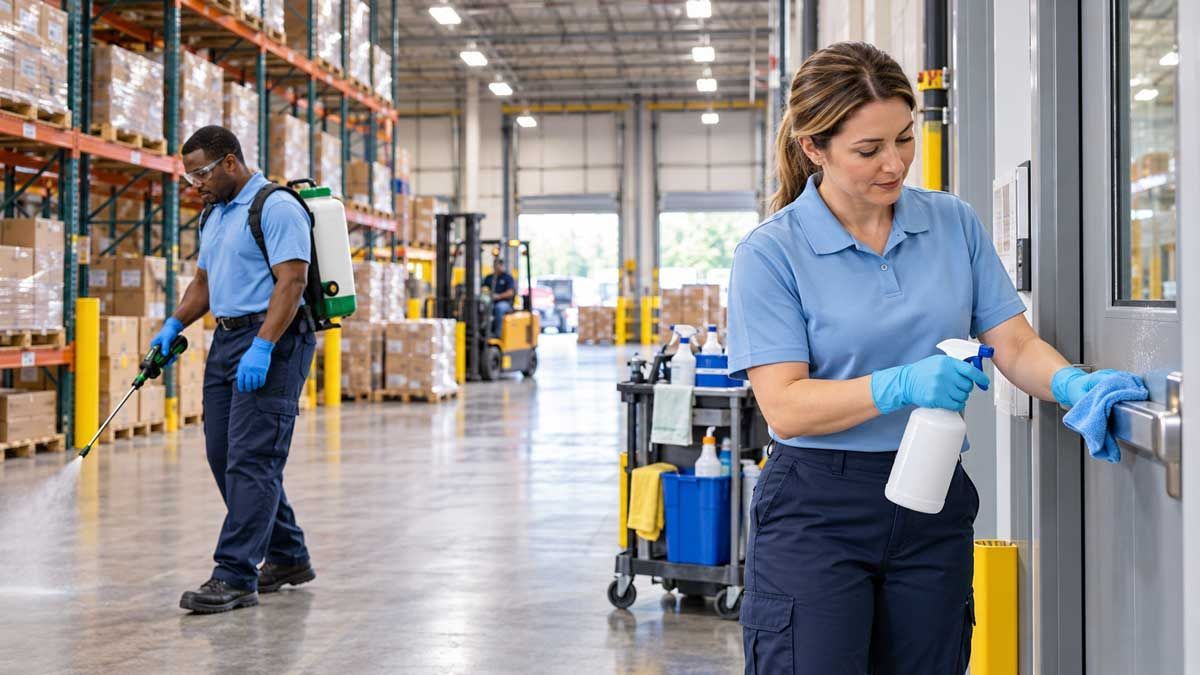
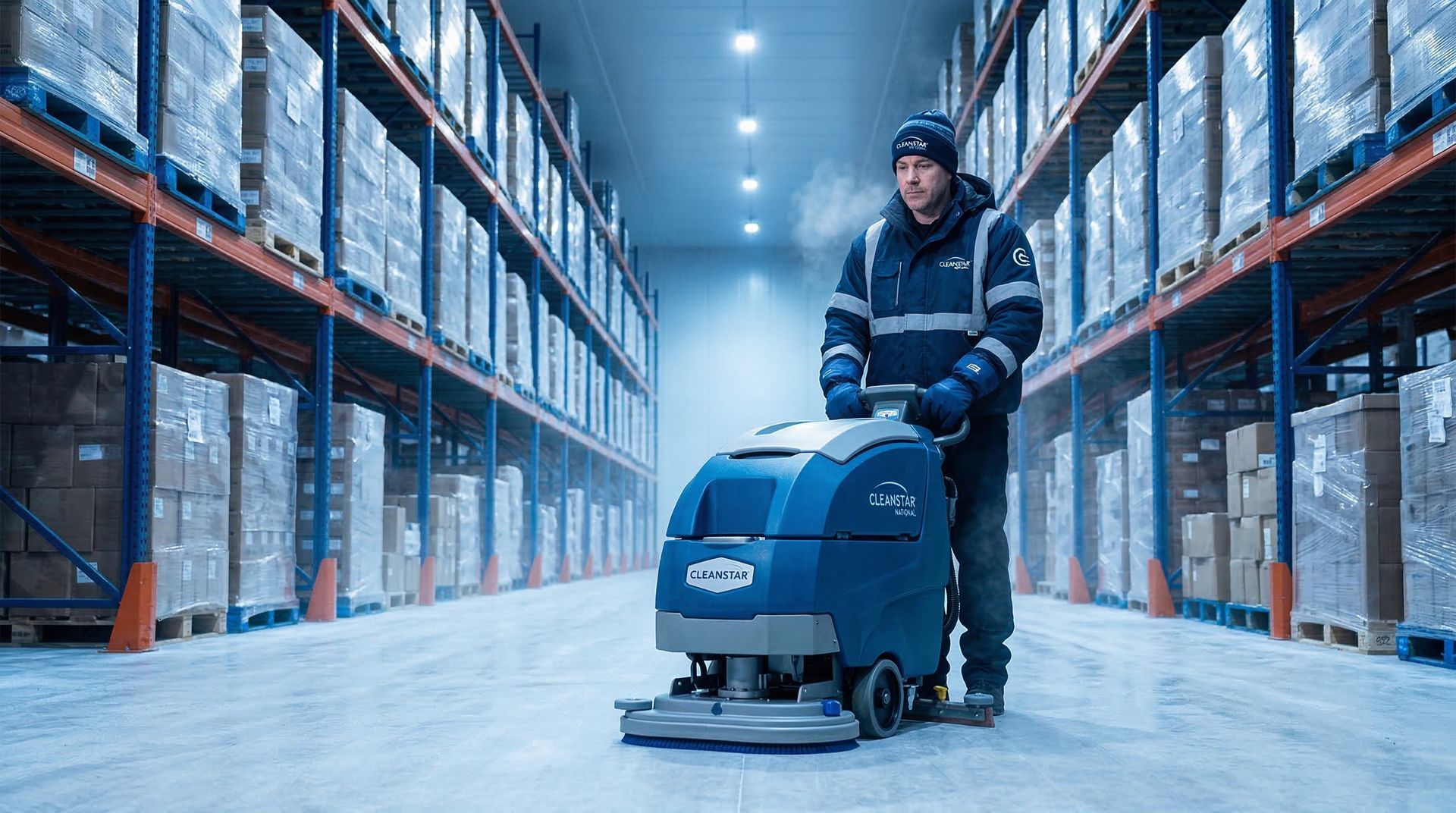
Industrial cleaning involves OSHA-intensive procedures, heavier floor care, and work around machinery and operational areas. Educational facilities prioritize high-traffic disinfection across classrooms, restrooms, and common areas, with scheduling that works around school hours. Corporate campuses need consistent multi-building coverage with enough staffing depth to maintain standards across every zone. Each of these is a distinct operational requirement. A company that cleans offices well doesn't automatically have the crew size or protocols to manage an industrial or educational contract at the same level.
Post-construction cleaning and emergency response
Post-construction cleaning is a project-based scope: removing construction dust and debris, cleaning fixtures and surfaces, and preparing a space for occupancy or client walkthrough. It's one-time work with specific sequencing, and it requires a team experienced with heavy-duty cleanup in demanding environments. Separately, 24/7 emergency response capability matters when a biohazard spill, flooding event, or pre-event turnaround happens outside business hours. Many firms advertise 24/7 response; verify their on-call staffing and ask for documented response times before you take that claim at face value.
4. How commercial cleaning in Atlanta is priced
Most businesses ask for a price before they understand scope, which is why quotes are impossible to compare fairly. Here's how pricing actually works so you know what you're evaluating.
The two main pricing models and what Atlanta rates look like
Recurring office cleaning in Atlanta typically runs $0.09 to $0.18 per square foot, or $35 to $60 per hour for hourly-rate work. These figures reflect 2026 local market conditions and are consistent with published janitorial industry benchmarks. In practice, most recurring contracts settle into a flat monthly fee after an on-site walkthrough, which is usually the most cost-effective format for consistent service. As a rough benchmark: small offices run $150 to $300 per visit, medium facilities $300 to $700, and larger commercial buildings $700 to $2,000 or more depending on scope and frequency. For a current industry breakdown of 2026 per-square-foot benchmarks, see commercial cleaning rates per square foot (2026).
What pushes a quote higher: specialization, frequency, and certifications
Medical, post-construction, and industrial scopes don't fit standard per-square-foot pricing because the protocol requirements, equipment, and certified staff involved are fundamentally different. Frequency also affects per-visit cost: weekly contracts typically land at the lower end of the range, while less frequent service pushes rates higher. If a vendor quotes you significantly below these ranges with no explanation, that's worth investigating, low bids can indicate underpricing that doesn't account for actual labor and compliance costs. Request a detailed cost breakdown and references before you accept any quote that looks too good.
5. Response time and quality accountability
A cleaning company can do excellent work on day one and become unreliable by month three. Quality accountability systems are what separate a one-time vendor from a long-term facility partner.
24/7 availability: when it matters and how to verify it
Emergency cleaning scenarios include biohazard spills, water intrusion, and pre-event turnarounds that can't wait until morning. Many Atlanta janitorial companies list 24/7 availability on their websites, but listing it and staffing for it are different things. When evaluating a vendor, ask specifically: how quickly can you respond to an after-hours emergency call, and who is your point of contact when something happens at 11 p.m.? A real answer involves a specific number and a named on-call protocol. A vague answer is a red flag.
Photo-verified checklists and service reporting
Transparent reporting means photo-verified task completion, detailed service logs, and written documentation of what was done and when. This protects both parties and makes performance measurable rather than subjective. When a complaint arises, a company with documented reporting can show exactly what happened. A company without it can only tell you it was done. That's not accountability. That's a conversation.
Satisfaction guarantees and how to evaluate them
A credible satisfaction guarantee includes free return visits if standards aren't met, a clear escalation process, and a documented quality review structure. Contrast that with verbal assurances that aren't backed by written policy. The question to ask is simple: if your team misses something, what happens next, and is that written into the contract? If the answer is a guarantee backed only by a handshake, it's worth pressing harder before you sign.
6. The questions to ask before you sign a janitorial contract
If you've evaluated compliance, staffing, scope, price, and accountability, these questions lock in the details before anything is signed.
Scope, schedule, and pricing questions
Start here: What areas are included and what's excluded? How are tasks broken out by frequency, daily, weekly, monthly? Is pricing fixed or variable, and what triggers extra charges? Who supplies equipment and cleaning products, and are Safety Data Sheets available on request? Require a written scope of work, a service schedule, and a full pricing breakdown in the same proposal document. If a vendor can't produce all three before you sign, they're not organized enough to manage your account reliably. If you want a starting point for standardizing proposals, a cleaning services proposal template can help you capture scope and pricing consistently.
Contract terms, references, and performance verification
Review termination clauses, renewal terms, and what happens when service standards aren't met before anything else in the contract. Ask for two or three verifiable Atlanta, GA client references in the same industry vertical as your facility, ideally in areas like Buckhead, Midtown, or Sandy Springs where building types vary significantly. A company with a long Atlanta client roster can show you performance history across real accounts. That's a fundamentally different level of confidence than a vendor who promises results they haven't demonstrated in your market.
Frequently asked questions about commercial cleaning in Atlanta
What certifications should a commercial cleaning company in Atlanta carry?
At minimum, look for a current City of Atlanta Occupational Tax Certificate, commercial general liability insurance, and workers' compensation coverage. For medical or healthcare environments, OSHA bloodborne pathogen training and EPA-registered disinfectant usage are required. Ask to see documentation for all of it, certificates on request are a basic professional standard.
How do I get janitorial service quotes in Atlanta?
Request an on-site walkthrough before any quote is issued. Square footage, facility type, access requirements, and cleaning frequency all affect the final number. Any janitorial service quotes for Atlanta facilities should include a written scope of work, a schedule, and a line-item pricing breakdown, not just a monthly total.
What's a fair price for commercial cleaning in Atlanta in 2026?
Recurring office cleaning runs approximately $0.09 to $0.18 per square foot or $35 to $60 per hour. Specialized scopes like medical office cleaning or post-construction cleaning are priced separately based on protocols and crew requirements. If a quote comes in well below these ranges without explanation, ask for a cost breakdown.
Does Cleanstar National serve the full Atlanta metro area?
Yes. Cleanstar National provides commercial janitorial services across Atlanta and the surrounding metro, including Buckhead, Midtown, Sandy Springs, and neighboring communities. Contact us directly to confirm coverage for your specific location.
Hold every company to the same standard
There's no shortage of commercial cleaning companies in Atlanta. Finding one that checks every box, compliant, properly staffed, scoped for your facility, fairly priced, and accountable over time, requires asking specific questions before you commit. The checklist from section six works for any vendor evaluation, regardless of company size or contract value.
Cleanstar National Inc has served Atlanta facilities for over three decades, working with clients across Buckhead high-rises, medical campuses, post-construction sites, and educational institutions. The standard is straightforward: show up with documentation, send vetted people, deliver what was quoted, and fix problems without being asked twice. That's the bar every provider of commercial cleaning in Atlanta, GA should be held to.
If you're ready to evaluate your current vendor or shortlist new ones, start with the compliance and staffing questions. Everything else follows from there. And if you want to see what a proposal from a company that has been doing this since 1995 actually looks like, reach out to Cleanstar National for a free on-site estimate. We'll bring the documentation.
Cleanstar National: Expert B2B Cleaning Solutions for Atlanta's Critical Industries