Pharmacy & Aseptic Cleaning Contracts: Plan Beyond the First Visit
The first clean is only the start.
The first visit goes well. Then a trained technician is absent, a room cannot be released and another location needs a different service window. Does the agreement explain what happens next?
For pharmacy directors, environmental-services leaders, facility managers and procurement teams, a long-term cleaning contract should make the assigned work dependable—not simply put visits on a calendar.
This guide helps you compare recurring pharmacy and aseptic cleaning proposals, coordinate multiple locations and decide what evidence to review before renewal.

Match the service to the environment.
Pharmacy cleaning identifies the setting and assigned work. In this service context, aseptic cleaning means environmental cleaning and disinfection intended to support contamination prevention. Neither makes ordinary surface cleaning equivalent to sterilization. CDC distinguishes cleaning, disinfection and sterilization as different processes. [1]
Pharmacies and compounding areas
Identify room use, surfaces, access, preparation and documentation. Cleanstar National’s pharmacy and compounding-area cleaning page explains the service scope.
Healthcare and technical spaces
Define the routine or terminal-cleaning assignment, service triggers and facility responsibilities. Review aseptic and terminal cleaning services for these environments.
A pharmacy suite, operating room and research laboratory should not inherit identical procedures. The connection is disciplined service management—not a universal chemical, frequency or technique.
For pharmacies, USP <795> addresses nonsterile compounding, <797> addresses sterile compounding, and <800> addresses hazardous-drug handling. The applicable requirements depend on the operation. Chapter references are not cleaning-company certifications. [2] [3] [4]
Choose recurring service, supplemental support or project work.
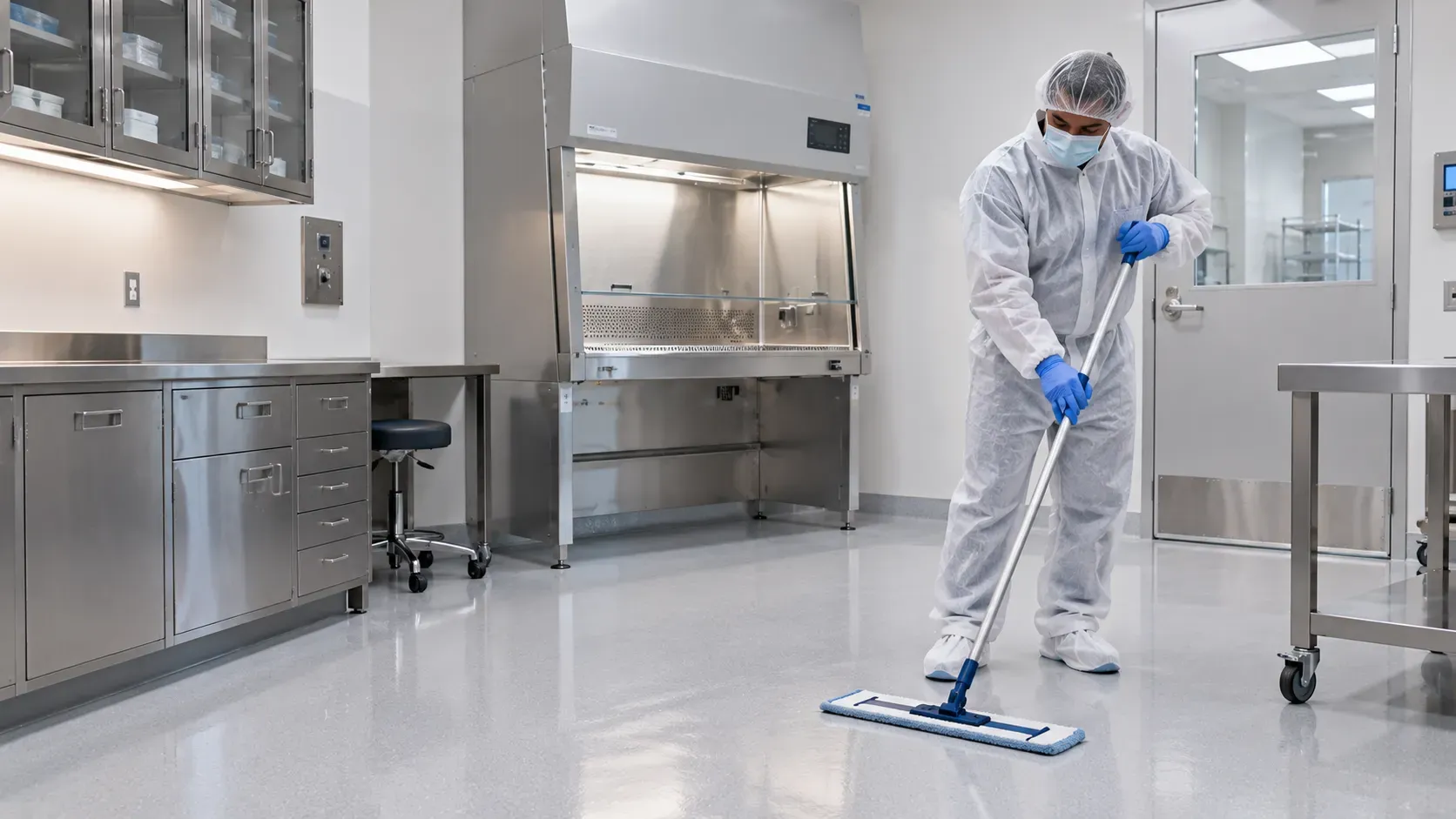
Recurring service covers agreed tasks and ongoing oversight. Supplemental support assigns particular areas or service windows alongside an internal team. Project cleaning addresses a defined event or condition; it does not automatically maintain the space afterward.
State the model in your request for proposal. Identify both sides of every handoff: who prepares the area, who cleans it, who reviews the work and who maintains it next.
Five requirements to put in writing.
CDC’s healthcare-surface framework emphasizes responsibilities, training, setting-specific procedures, monitoring and feedback. Its scope is acute-care hospitals, with additional considerations for other healthcare settings; it does not replace pharmacy-specific requirements. [5]
- The assignment at each location Specify rooms, surfaces, tasks, service intervals and exclusions. Name who clears counters, protects supplies and authorizes access. Separate any existing cleaning backlog from routine maintenance. For controlled rooms, use the cleanroom cleaning scope to identify the actual work.
- Personnel and backup coverage Identify supervision, replacement arrangements and any subcontracting. Ask how personnel demonstrate competence for the assigned tasks before working independently. A promise to send someone is not evidence that the replacement is prepared for that facility.
- Products, tools and procedure changes Record approved materials, storage arrangements and how revised instructions reach the team. EPA-registered disinfectants must be used according to their labels, including maintaining the required contact time. Scheduling pressure does not replace the instructions. [6]
- Completion evidence and corrective action Agree on the task record, review criteria and follow-up owner. Distinguish completed work, inaccessible areas, missed tasks and maintenance referrals. A supervisor’s review should identify what was checked and what still needs correction—not simply whether someone attended.
- Commercial changes and service continuity Define approval of additional rooms, visits, frequencies and locations. Clarify included supplies, periodic work, notice requirements, record handover and transition responsibilities through your procurement process. The agreement should remain usable when the facility changes.

Ask these six questions before choosing a provider.
Use ordinary disruptions to test whether the proposal describes a working service. For each answer, ask for the responsible role, next action and supporting record. These are suggested procurement questions—not a certification test.
- The assigned technician is absent. What happens next?
- Ask who covers the work, how task preparation is confirmed and who notifies the facility. Look for a replacement process, not an unsupported staffing guarantee.
- A room is unavailable during the service window. How is it handled?
- The record should identify the blocked task, notification and next-action owner. An inaccessible room must not silently become a completed cleaning entry.
- A product or procedure changes. How does the team know?
- Ask how the revision is approved, communicated and incorporated into training and job instructions. Identify who prevents continued use of the superseded procedure.
- A new pharmacy joins the portfolio. What must happen before service?
- Require a location-specific scope, access plan, personnel preparation and confirmed start arrangements. The existing contract should not substitute for assessing the new site.
- The same problem keeps returning. Who checks the cause?
- Ask how the issue is investigated, corrected and reviewed for closure. Repeating an exception in successive reports is not the same as resolving it.
- The provider changes. How is the handoff managed?
- Identify the records, keys, access permissions and service responsibilities to transfer. Assign owners on both sides and establish the first shift under the new arrangement.
A useful answer names the person, process and evidence. “We take quality seriously” is an introduction—not the answer.
Compare equivalent scopes—not just monthly totals.
Give every bidder the same location list, room information, service intervals and access assumptions. Ask for separate entries for recurring service, periodic work, consumables, mobilization and additional authorized tasks.
A square-foot rate needs a defined unit: per visit, per month or per project. Confirm the number of included visits and whether preparation, supervision, records and travel are covered. Do not treat an omitted task as included because the overall price is lower.
For multiple facilities, request site-level pricing and a portfolio summary. Compare the same contract period and assumptions, keeping optional work separate from committed service.
Long-term value comes from work that can be delivered and reviewed—not merely a long contract term. A compact controlled room can have substantial procedural demands, while a large project may be one-time work. Size alone does not establish the right service model.
Ask for evidence relevant to your rooms and tasks.
Request an approved scope example, task-specific competency evidence, an anonymized service record and the proposed supervision arrangement. For any credential, identify its holder and applicable scope instead of assuming that a badge qualifies every employee for every assignment.
Cleanstar National’s healthcare and institutional experience includes work for Grady Memorial Hospital, Piedmont Healthcare, Emory University, Emory Healthcare facilities and the University of Georgia. These are organizational references, not a claim that every institution purchased pharmacy cleaning or every technical service.
For mixed portfolios, our biotech and laboratory cleaning services address a separate discussion of work areas, protected research materials and access. Keep the evidence matched to the proposed assignment.
Make startup and renewal reviews measurable.
Before service begins, record the baseline condition, existing backlog, approved scope, supplies, contacts and review date. During startup, compare those assumptions with the actual work and access available.
Use a short review record rather than an unexplained quality score. These are suggested management measures; they are not claimed Cleanstar National results or universal acceptance thresholds.
- Scheduled versus completed work
- Show scheduled, completed, blocked and canceled assignments separately. Preserve the reason and next action rather than removing incomplete work from the report.
- Inspection and correction
- Record what was inspected, which criterion was not met, the corrective action and the reviewer who checked closure. Keep inspection coverage visible.
- Personnel readiness
- Check that people assigned to changed tasks or replacement shifts have the required preparation and documented authorization.
- Recurring exceptions
- Track unresolved and repeated issues, their owners and agreed due dates. Distinguish a cleaning correction from a repair assigned to maintenance.
Cleaning records, environmental monitoring and certification answer different questions. A completed checklist does not establish sterility. Before renewal, assess the actual delivery record and changes in the facility—not just whether the invoice stayed the same.
Plan Georgia coverage around the contract.
Cleanstar National considers suitable contracted work statewide. Coverage discussions include Metro Atlanta, the Athens corridors, Macon, Douglasville, Carrollton, LaGrange, Columbus and North Georgia communities such as Helen and Blue Ridge. These are examples, not fixed service boundaries.
For a regional portfolio, provide the locations and service windows together. Staffing, task requirements, frequency, travel and access determine the delivery plan. Your procurement office can be outside Georgia while the facilities requiring service are in Georgia.
Review our Georgia service-area overview, then identify the addresses in your proposal. Campus, office and warehouse spaces may belong to the same account without requiring the same pharmacy procedures.
Questions about recurring cleaning contracts
Can one provider support pharmacy cleaning and terminal cleaning?
Yes, when the provider’s capabilities match both assignments. Keep separate room lists, procedures, personnel requirements and service triggers. A single agreement can coordinate oversight without treating a pharmacy cleanroom and a hospital procedure area as the same environment.
Can outsourced cleaning supplement an internal team?
Yes. Define the rooms, tasks and service windows assigned to the contractor and those retained by facility personnel. Include preparation, access, completion review and follow-up so work does not fall between the teams. Outsourcing does not have to replace the entire internal program.
What should a multi-location cleaning proposal include?
Include a separate scope and pricing explanation for each location, supported by shared reporting and escalation arrangements. Identify required service intervals, responsible contacts, personnel preparation, access and materials. Explain how new locations and changed procedures will be assessed and approved.
What information is needed to request a recurring cleaning quote?
Start with the Georgia facility locations, pharmacy or healthcare setting, areas requiring service, requested frequency and target start or renewal date. Explain whether you need a recurring program or support alongside an internal team. Mention an existing scope or RFP so Cleanstar National can arrange the next step.
Sources and technical context
- CDC: Cleaning, disinfection and sterilization definitions.
- USP <795>: Nonsterile-compounding chapter scope.
- USP <797>: Sterile-compounding chapter scope.
- USP <800>: Hazardous-drug handling chapter scope.
- CDC: Core components of environmental cleaning in healthcare.
- EPA: Registered disinfectants and directions for use.
This is a procurement-planning guide, not a clinical procedure. USP links provide chapter-scope previews rather than complete procedural text. Facility requirements and product instructions govern the work. The examples and imagery are illustrative; references do not endorse Cleanstar National.
Cleanstar National: Expert B2B Cleaning Solutions for Atlanta's Critical Industries