School & University Cleaning: A Break-Period Checklist for Georgia Campuses
A break in classes is not a campus shutdown.
Classes stop, but the building does not always empty. An athletics event may still need the gym, an administrative office may remain open, and maintenance crews may be working in the corridor scheduled for floor care.
For Georgia school business officers, district facilities teams and university operations leaders, a useful break-period cleaning plan starts with the spaces that can actually be released—not the first date on the academic calendar.
Use this framework for winter break, spring break or summer planning. It is a management checklist, not a universal cleaning procedure or a substitute for the institution’s requirements.
Before the break: work from the real building calendar.
Start with the last occupied day, the first day staff return and any activity between them. A classroom may be available while the library, dining space or residence building remains in use. A teacher workday may also precede the students’ return.
Ask each building contact to confirm events, camps, research activity, office hours, deliveries and contractor visits. Use room or zone status—occupied, available, restricted or awaiting release—instead of marking the whole campus “closed.”
- Identify the assignment: list the rooms, accessible surfaces and tasks, including any additional periodic floor care.
- Assign preparation: name who clears desks, secures records, moves authorized furniture and protects equipment or personal belongings.
- Confirm access: establish permitted hours, check-in requirements, escorts and the contact who can resolve a locked or unavailable room.
- Set the return-to-use deadline: agree on the completion review and when each area must be available for its next actual use.
That information makes school, college and university cleaning a defined assignment rather than a request to “deep clean everything.”
Separate routine cleaning, break projects and repairs.
A holiday closure does not automatically require every floor to be stripped or every room to receive the same treatment. Review the condition, intended task and surface instructions before setting the scope.
Routine service that continues
Keep necessary cleaning in occupied offices, restrooms, libraries and event areas on the schedule. Confirm how staffing and access change during the break.
Planned break-period work
Identify approved tasks that benefit from additional access: carpet extraction, detailed cleaning of cleared surfaces or separately assessed floor restoration.
Maintenance or specialist work
Assign leaks, damaged finishes, equipment faults and suspected hazardous conditions to the appropriate team. A cleaning visit does not establish that a repair was completed.
Record pre-existing damage and backlog during the walkthrough. Price any initial reset separately from the recurring program so both parties understand what the first visit is intended to accomplish.
Choose the tasks by campus space.
Use the room list to agree on accessible surfaces, protected items and responsibilities. Confirm specialist spaces separately before including them in the proposal.
- Classrooms and lecture rooms
- Identify cleared desks, approved touchpoints, accessible ledges and floors. Confirm who handles teaching materials, displays, electronics and furniture before cleaning begins.
- Libraries and administrative offices
- Agree on accessible surfaces, carpets and shared areas. Keep archives, books, confidential records and occupied workstations under the control of the responsible campus staff.
- Corridors, entrances and common areas
- Scope floor care, entrance mats, accessible glass and shared touchpoints. Coordinate delivery routes and foot traffic so completed areas are not immediately used by another crew.
- Restrooms and changing areas
- Define fixture, partition, floor and supply tasks. Separate cleaning from plumbing repairs, damaged dispensers and other work requiring maintenance follow-up.
- Dining, athletics and event spaces
- Confirm events, room setups and surface-care instructions. A dining-room assignment does not automatically include food-preparation equipment, and a gym floor may require a different plan from a corridor.
- Restricted or occupied spaces
- Assess laboratories, clinics, residence rooms and controlled storage separately. Obtain appropriate authorization and procedures; an academic break does not release these spaces for general cleaning.
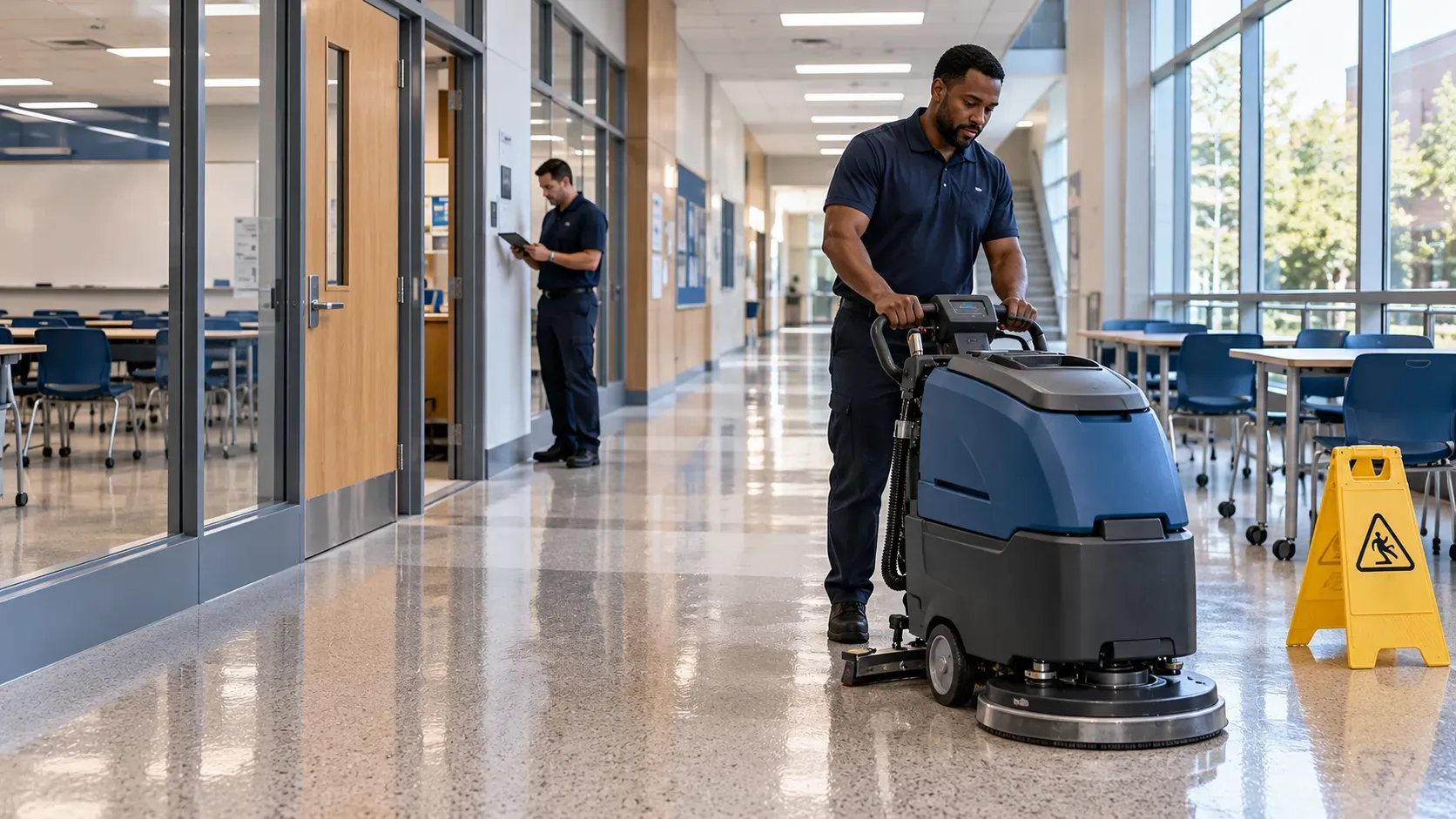
Protect the time needed for floor care.
A floor-care window includes preparation, the assigned treatment, any required drying or curing, and the agreed return of furniture and traffic. Do not book another use of the area based only on the time the machine leaves.
EPA’s school indoor-air-quality framework recommends following flooring manufacturers’ maintenance guidance and performing restorative work when needed. It also addresses scheduling pollutant-releasing activities while schools are unoccupied. Those recommendations support careful planning—not a universal refinishing calendar.
Match commercial floor care to the actual carpet, resilient flooring, tile, wood or other finish. Confirm the approved products, equipment, drying conditions and return-to-use instructions. Do not apply one method across every room because it is convenient for the schedule.
Coordinate ventilation and building-system operation with authorized facilities personnel. When several contractors are involved, identify who controls the area and who confirms that the next activity can begin.
During the break: sequence the work and record exceptions.
Ask which trades will enter an area after cleaning. Painting, ceiling access, equipment installation and furniture moves can change the condition of completed spaces. Agree on area release, protection and any return visit before work begins.
If a room remains locked or its surfaces are not cleared, record the affected task, notified contact and next action. Distinguish missed work from blocked access and from new cleaning caused by later activity.
Use a consistent record: building and room → assigned task → release time → completion or exception → follow-up owner → review. Photos can support a record when permitted, but should not expose student information, sensitive documents or access details.
Keep cleaning and disinfection decisions specific.
A break-period clean is not a promise that a school has been sterilized or that future illness will be prevented. Describe the tasks and methods actually assigned.
CDC’s guidance for schools recommends routine cleaning practices and directs schools to local policies or requirements for specific areas. It advises consulting state or local health departments when an outbreak or particular pathogen may require enhanced cleaning. The guidance is not a universal procedure for every university laboratory or clinic.
Where disinfection is required, EPA’s product-label guidance governs permitted uses and application conditions, including the required wet contact time. A short break window does not justify substituting an unapproved product or shortening a required step.
Before reopening: review more than the checklist’s final box.
Schedule the completion review before the first returning occupants need the space. Name a reviewer and backup rather than relying on whoever happens to be on site.
- Work status: review the rooms and tasks actually completed; list inaccessible areas and unresolved items separately.
- Surface readiness: confirm the applicable drying, curing and access conditions rather than assuming a floor that looks finished is ready for use.
- Room setup: verify authorized furniture placement, cleared routes and the removal or secure storage of cleaning equipment and supplies.
- Repair handoffs: identify the owner and status of maintenance referrals. “Reported” does not mean “repaired.”
- Communication: tell the building contact which areas are ready under the institution’s process and which remain restricted.
- Routine service: confirm the next cleaning shift, restroom supplies, daytime coverage and the request contact for the first occupied day.
This is a cleaning completion review—not a building-safety certification. Reopening decisions and any separate inspections remain with the institution’s authorized teams.
Use the break to improve the recurring program.
A one-time project does not replace cleaning after normal activity resumes. Use the completion review to identify recurring gaps: classrooms that cannot be accessed, restrooms that need daytime attention or common areas affected by evening events.
Separate any proposed change from the existing contract. Identify the additional task, coverage window, responsible team and price before treating it as included. A day porter program can be discussed for occupied shared areas without replacing every after-hours task.
For a district or multi-campus account, use common reporting fields but retain a site-specific room list and schedule. A K–12 building, university library and technical-college workshop should not receive identical assignments simply because procurement is centralized.
Give bidders the same work to price.
Share the building list, approximate cleanable areas, floor types, requested tasks, occupied zones and available work windows. Identify furniture handling, supplies, waste arrangements and any separately authorized return work.
ISSA’s cleaning RFP guidance emphasizes clear operational specifications and current building information. For a campus break, ask for separate pricing for the initial project, optional work and any proposed recurring service—not one unexplained “deep clean” total.
Formal school and university solicitations should follow the institution’s authorized procurement process. A public quote form can begin a scope discussion; it does not replace the required bid-submission channel.
Plan around your Georgia campus—not a statewide closure date.
Cleanstar National plans educational-facility cleaning around the rooms, schedules and access requirements of each property. Metro Atlanta is the home market, with suitable contracted work elsewhere in Georgia considered according to location, scope, staffing, frequency and timing.
Review the Georgia service-area overview and provide the actual campus addresses. Confirm each institution’s winter, spring or summer calendar, including staff return dates and events; do not assume every school or college closes together.
School and university break-cleaning questions
What should be cleaned during a school break?
Start with the rooms that can be released and the work their condition requires. The scope may include detailed cleaning of cleared classroom surfaces, common areas, restrooms and separately planned floor care. Keep routine service in occupied buildings and specialist or restricted-area tasks distinct.
How far in advance should a campus arrange break cleaning?
Begin once the institution can identify likely dates, access windows and priority tasks. Confirm the final scope early enough to coordinate staffing, materials, other contractors and required drying or curing. There is no single lead time that guarantees availability for every campus.
Can work continue while part of the campus is occupied?
Some tasks may be phased into released rooms or separate operating windows. Other work requires an unoccupied area and additional controls. Agree on access, separation and return-to-use requirements with the facility team; do not assume the whole campus can remain unrestricted during every treatment.
Does every school break require floor stripping or disinfection?
No single treatment belongs in every room by default. Floor care depends on the finish, condition and manufacturer instructions. Cleaning and disinfection should follow the facility’s procedures and applicable product directions rather than the holiday calendar alone.
Can break-period cleaning support a recurring campus contract?
Yes. A proposal can distinguish the break project from scheduled cleaning after reopening, with separate tasks, service windows and responsibilities. For multiple locations, keep the scope specific to each property while coordinating account-level reporting and review.
This checklist is a planning resource, not an institution-specific cleaning procedure, safety certification or compliance guarantee. Facility requirements and applicable product, surface and equipment instructions govern the work. The scenario is illustrative; external references do not endorse Cleanstar National.
Cleanstar National: Expert B2B Cleaning Solutions for Atlanta's Critical Industries