
A procurement-ready framework for defining zones, ownership, frequency, access, exclusions, staffing and quality control before large commercial kitchens request or compare service bids.
What should a commercial kitchen cleaning scope of work include?
A commercial kitchen cleaning scope of work should identify the facility and operating schedule, every included zone, exact tasks, service frequency, responsible party, access window, equipment-movement rules, approved methods, safety requirements, quality-control process and specialty exclusions. It should also explain how blocked work, added service and corrective action will be documented and approved.
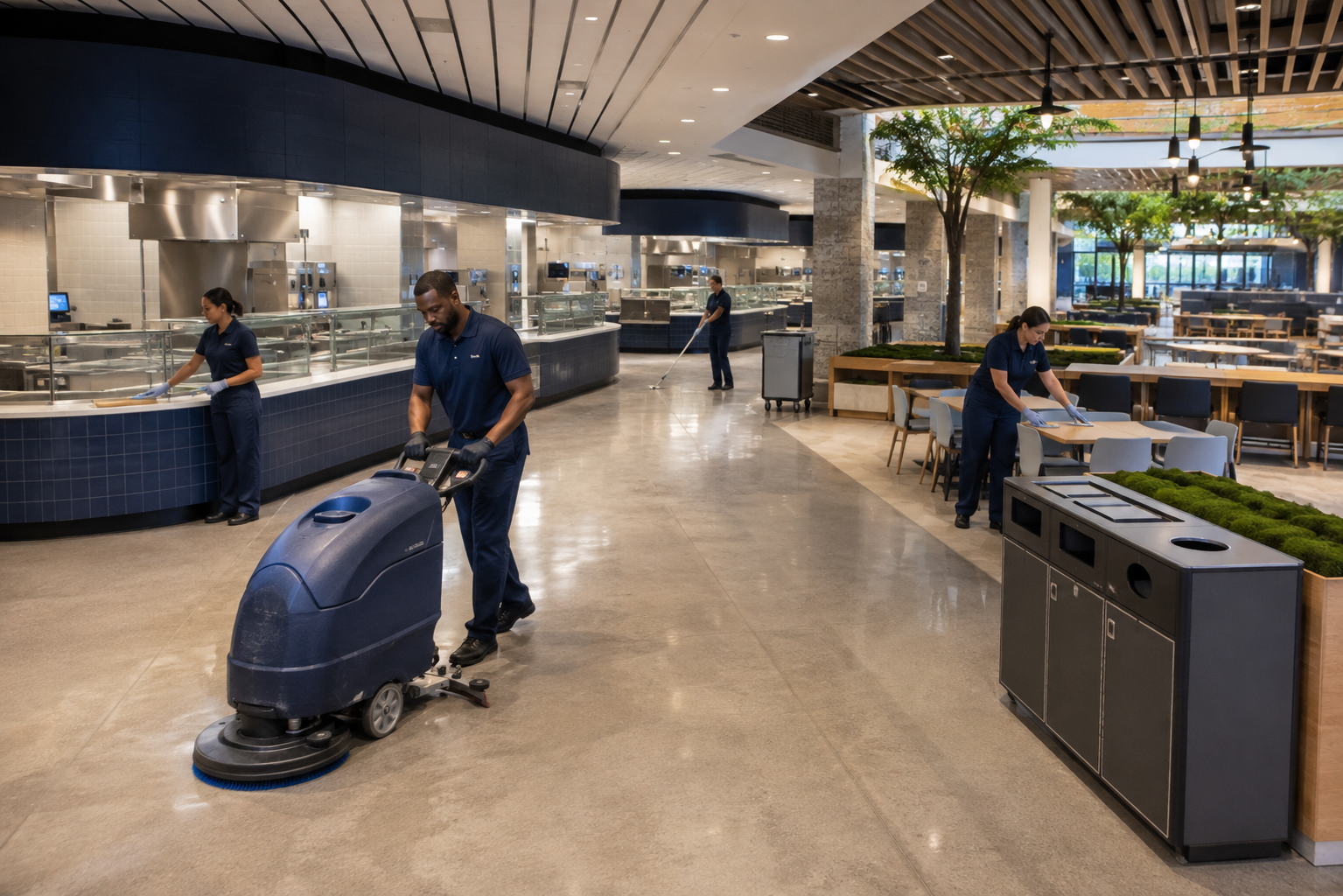
For a large cafeteria, hotel, food hall or industrial kitchen, the scope should extend beyond the cook line to warewashing, service areas, dining spaces, restrooms, corridors, receiving transitions and waste routes where included. Food-contact sanitation, equipment servicing, exhaust-system cleaning, grease management and licensed specialty work must be assigned or excluded explicitly rather than hidden inside “complete kitchen cleaning.”
Most commercial kitchen cleaning disputes begin before a contract is signed. One bidder assumes equipment will be moved by the client. Another includes the dining area but excludes restrooms. A third interprets “deep clean” as detailed floor work while the facility expects internal equipment and exhaust cleaning. The prices cannot be compared because the proposed services are not the same.
A disciplined scope turns expectations into an operating document. It also helps facility and procurement teams evaluate whether a provider understands the building rather than simply offering the lowest number. Use this guide with Cleanstar National's commercial kitchen cleaning services, the large-facility kitchen cleaning checklist and the commercial kitchen deep-cleaning frequency guide.
Why do generic commercial kitchen cleaning scopes fail?
Generic scopes list familiar verbs—sweep, mop, wipe, disinfect, deep clean—but omit the conditions that determine labor and outcome. They do not say which surfaces are food-contact, who releases each zone, whether equipment can be moved, which floor types are present or how the facility will judge completed work.
The boundaries are invisible
Kitchens connect to storage, dining, loading and waste areas. When drawings or zone lists are absent, each bidder chooses a different service boundary and prices a different job.
Responsibility is duplicated or omitted
Food-service staff, facility staff, janitorial teams and specialists may share the same environment. If ownership is implied, critical work can be repeated, missed or performed by a team that was never authorized to do it.
Frequency is disconnected from access
A task scheduled weekly is not executable until the scope states when production releases the zone, how long it remains available and what restrictions apply during the window.
Quality is reduced to appearance
“Clean to satisfaction” invites inconsistent interpretation. The scope needs defined inspection locations, exception reporting, response ownership and a closeout method.
What facility data should be included before requesting bids?
Begin with facts that affect staffing, equipment, timing and risk. Provide the same information to every invited provider and use a joint walkthrough to resolve gaps. When exact measurements are unavailable, state that bidders must verify them rather than quietly estimate.
- Facility type, address and operating use
- Total relevant square footage and number of kitchens or service outlets
- Production schedule, peak periods, events and seasonal changes
- Available service days, release times and reopening deadlines
- Flooring, wall and major equipment-surface types
- Security, badging, parking, loading and key-control requirements
- Storage available for products, tools and equipment
- Utilities and approved water, drain or charging locations
- Existing food-safety, chemical and site-specific operating restrictions
- Baseline condition and whether an initial reset is required
If accumulated conditions exceed what routine service can maintain, request a separate initial-clean proposal. Approve the baseline after that project, then begin measuring the recurring contract. Otherwise, bidders must either price unknown legacy conditions into every visit or underbid the labor required to recover the facility.
How should the scope divide a large kitchen into zones?
Zone-based scopes are easier to price, staff, inspect and revise than one long task list. Give each zone an identifier that can appear on drawings, checklists, inspection reports and corrective actions. Within each zone, distinguish food-contact surfaces from general facility and non-food-contact cleaning.
Production and preparation
Cook-line perimeters, preparation areas, accessible equipment exteriors, floors, walls, edges and approved under-equipment locations.
Warewashing and utility
Warewashing-equipment exteriors, floors, splash areas, mats, accessible drains and chemical-storage housekeeping when included.
Service and dining
Service-line exteriors, queue areas, dining floors, furnishings, beverage-station exteriors, waste stations and guest-facing touchpoints.
Restrooms and public corridors
Fixtures, dispensers, partitions, floors, entrances, glazing, public transitions and replenishment responsibilities.
Storage, receiving and back of house
Dry-storage housekeeping boundaries, corridors, receiving transitions, loading interfaces and approved support areas.
Waste route and exterior boundary
Interior collection points, container exteriors, travel routes, dock areas or enclosures only where they are expressly included.
Who owns each commercial kitchen cleaning task?
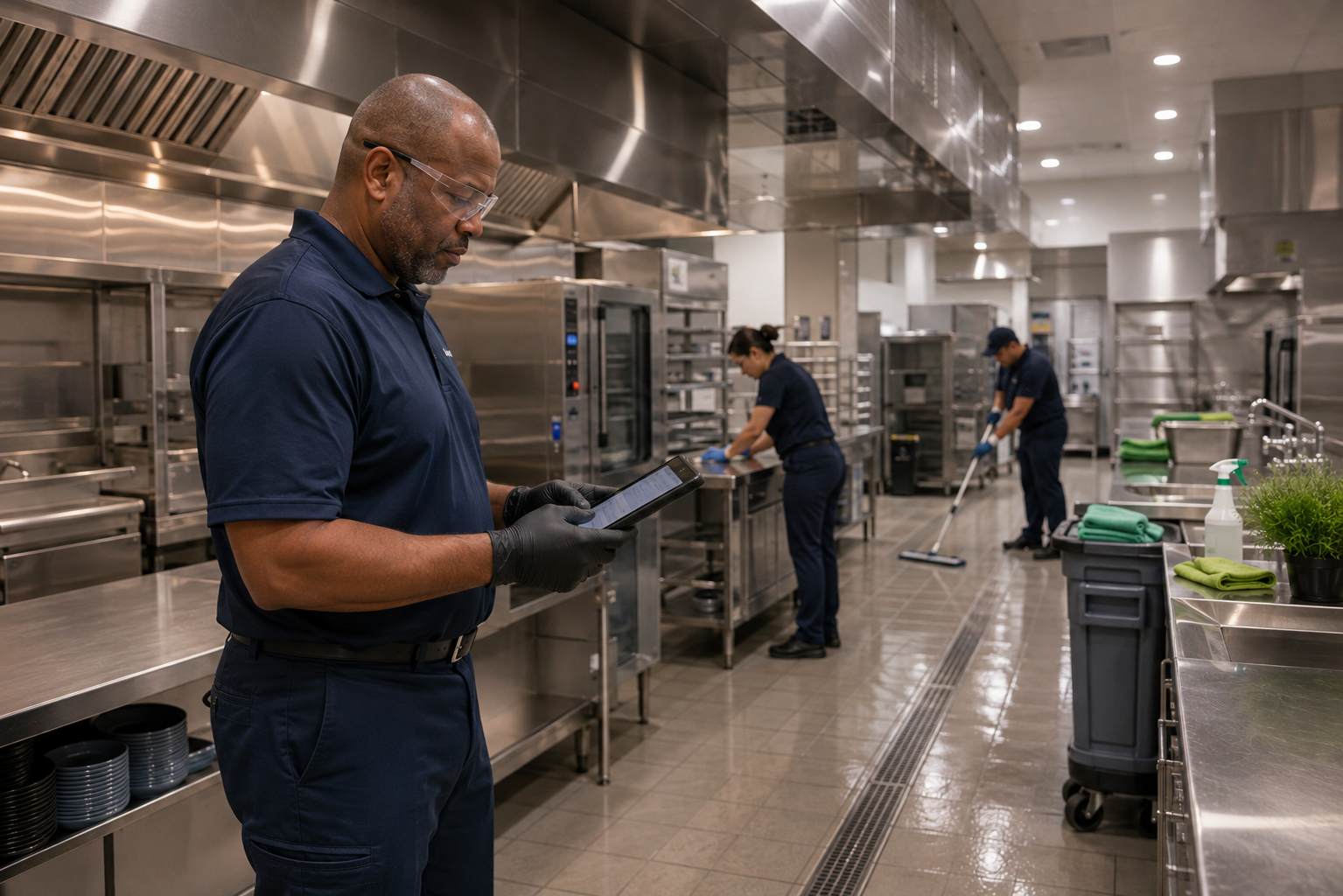
Create a responsibility matrix with one accountable owner for every task. Supporting teams may participate, but the document should name who releases the area, who performs the work and who accepts the result. This distinction is especially important where production and facility cleaning overlap.
| Responsible group | Typical scope questions | Required handoff |
|---|---|---|
| Food-service or sanitation team | Which food-contact surfaces, utensils and production equipment require controlled operational procedures? | When is the zone sanitized, cleared and released for facility cleaning? |
| Commercial cleaning partner | Which released floors, non-food-contact exteriors, dining spaces, restrooms, corridors and waste areas are included? | How are completion, blocked access and observed defects reported? |
| Facility or maintenance team | Who controls utilities, repairs leaks, moves restricted equipment and corrects damaged surfaces? | What conditions must be corrected before the cleaning task can proceed? |
| Qualified specialty provider | Which exhaust, fire-protection, grease-management, pest, hazardous-material or licensed tasks require separate scope? | What documentation or clearance is required before general cleaning resumes? |
The FDA Food Code provides detailed provisions for equipment, utensils and food-contact surfaces, while state and local jurisdictions determine the requirements applicable to a specific establishment. The FDA document is a model code rather than a universal federal operating rule, so the scope should direct the facility to its adopted requirements and internal food-safety procedures.
Authoritative reference: FDA 2022 Food Code.
How should frequency, service windows and access be written?
Every task needs both a frequency and an executable window. Replace “as needed” with an observable trigger or approval process. Replace “weekly” with the day or rotation, release condition, duration and responsible access contact. For variable event operations, include a method for requesting surge or post-event service.
- During operations: name the operational team responsible for spills, immediate hazards and controlled food-contact work.
- Daily release: identify the zones available after closing and the deadline for reopening.
- Rotating detail work: list weekly or periodic zones so the entire facility receives attention over a documented cycle.
- Monthly or quarterly projects: state additional labor, shutdown, equipment movement and acceptance needs.
- Event-based work: define the request lead time, authorization and pricing mechanism.
Use the commercial kitchen deep-cleaning frequency guide to establish a planning matrix. The final interval should respond to production volume, soil load, surfaces, access and inspection results rather than a copied calendar.
What chemical and safety information belongs in the scope?
The facility should identify who approves cleaning products, where current safety data sheets are available, which products are prohibited and what surface-compatibility or rinsing requirements apply. The scope should also address secondary-container labeling, storage, personal protective equipment, wet-floor controls and communication for non-routine work.
OSHA's Hazard Communication Standard requires workplace programs addressing labels, safety data sheets and employee information and training for hazardous chemicals. It also addresses communication at multi-employer workplaces. A commercial kitchen scope should connect the cleaning contractor's program with the facility's on-site rules rather than assuming one employer's documents automatically cover the other.
Which exclusions should be written into the scope?
Exclusions prevent unsafe improvisation and unplanned change orders. Do not rely on phrases such as “specialty work not included.” Name each boundary and identify whether the task is facility-owned, specialist-owned or available through a separate proposal.
- Internal hood, duct and commercial cooking exhaust-system cleaning
- Fire-suppression components, testing and inspections
- Grease traps, interceptors and regulated waste handling
- Internal food-production equipment cleaning or disassembly
- Movement of powered, plumbed, heated or restricted equipment
- Maintenance, repairs, utility isolation and correction of active leaks
- Pest-control treatment and structural remediation
- Mold, sewage, biohazard or hazardous-material response
- Work above the agreed height or requiring specialty access equipment
- Exterior loading, dumpster or pressure-washing areas unless specifically listed
When a necessary task is excluded, the facility should still assign it to an owner. A complete operating plan can include multiple providers; it cannot leave a known requirement without accountability.
What staffing, supervision and quality controls should bidders describe?
Ask bidders to explain how the written scope becomes a staffed and supervised program. Avoid prescribing an arbitrary crew count before the walkthrough; instead, require the provider to connect proposed labor to square footage, soil load, task frequency and the available service window.
- Proposed staffing model, shift structure and mobilization plan
- Named site supervision and escalation contacts
- Backup coverage and absence-management process
- Site-specific onboarding, access and chemical-safety training
- Equipment and product plan by surface and task
- Inspection locations, frequency and acceptance criteria
- Service records, exception reporting and communication method
- Corrective-action response, ownership and closeout
- Process for scope changes, added service and emergency requests
For a broader contract comparison, read Enterprise Janitorial Services vs. Standard Cleaning Contracts. High-volume kitchens usually need documented coverage and escalation, not an informal list of nightly tasks.
How should procurement compare commercial kitchen cleaning bids?
Normalize proposals before comparing price. Require bidders to acknowledge every zone, frequency and exclusion using the same response form. Place qualifications or alternatives next to the affected line rather than allowing them to disappear into proposal notes.
| Comparison dimension | What to verify | Warning sign |
|---|---|---|
| Scope alignment | Every bidder acknowledged the same zones, tasks and frequencies. | Proposal substitutes a generic task list. |
| Labor feasibility | Staffing and equipment fit the available release window. | Price includes no labor assumptions or production constraints. |
| Exclusions | Specialty boundaries and client responsibilities are explicit. | “Complete cleaning” appears without a responsibility matrix. |
| Quality assurance | Inspection, reporting, escalation and corrective action are defined. | Acceptance relies only on subjective satisfaction. |
| Commercial terms | Base service, initial reset, periodic projects and added work are separated. | Low base price depends on unspecified future add-ons. |
After selection, hold a kickoff walkthrough and reconcile the final scope, drawings, schedule, products, contacts and inspection method. A signed contract should incorporate the operating exhibits used to evaluate the bid rather than replace them with a shortened sales summary.
Related Cleanstar kitchen-cleaning resources
Commercial kitchen cleaning scope-of-work FAQs
What is a commercial kitchen cleaning scope of work?
It is the operating document that defines included zones, tasks, frequencies, responsibilities, methods, access, exclusions, inspection requirements and corrective action. It allows the facility and cleaning provider to price and manage the same work.
Should food-contact sanitation be included in the janitorial scope?
It should not be assumed. Food-contact work follows controlled procedures tied to the facility's food-safety program and applicable requirements. The scope should name the trained team responsible and define the handoff to broader facility cleaning.
Should bidders visit the facility before pricing?
Yes. A structured walkthrough helps bidders verify dimensions, conditions, surfaces, access, equipment restrictions and service windows. Provide the same information and question process to every bidder so the competition remains comparable.
Are exhaust hoods and grease traps included automatically?
No. Internal exhaust systems, fire-protection components, grease traps and interceptors commonly require separate scope confirmation and may need qualified specialty providers. List them as included, excluded or separately quoted.
How should additional cleaning requests be handled?
The contract should identify who can authorize added work, how requests are documented, applicable pricing or estimating rules and how completion is accepted. This avoids informal requests becoming disputed charges.
What is the best way to compare cleaning proposals?
Require every provider to respond to the same zone, task, frequency and exclusion matrix. Compare labor feasibility, supervision, quality control, corrective action and commercial terms only after confirming the scopes align.
What information is needed for an accurate commercial kitchen cleaning estimate?
Providers generally need facility type, relevant square footage, zone count, operating schedule, service window, surface types, current conditions, desired frequency, equipment-movement rules, specialty exclusions and security or onboarding requirements.