
A facility-focused scheduling guide for corporate cafeterias, hotels, food halls, institutional dining operations and industrial kitchens where cleaning frequency must follow soil load, production demands, access and documented food-safety responsibilities.
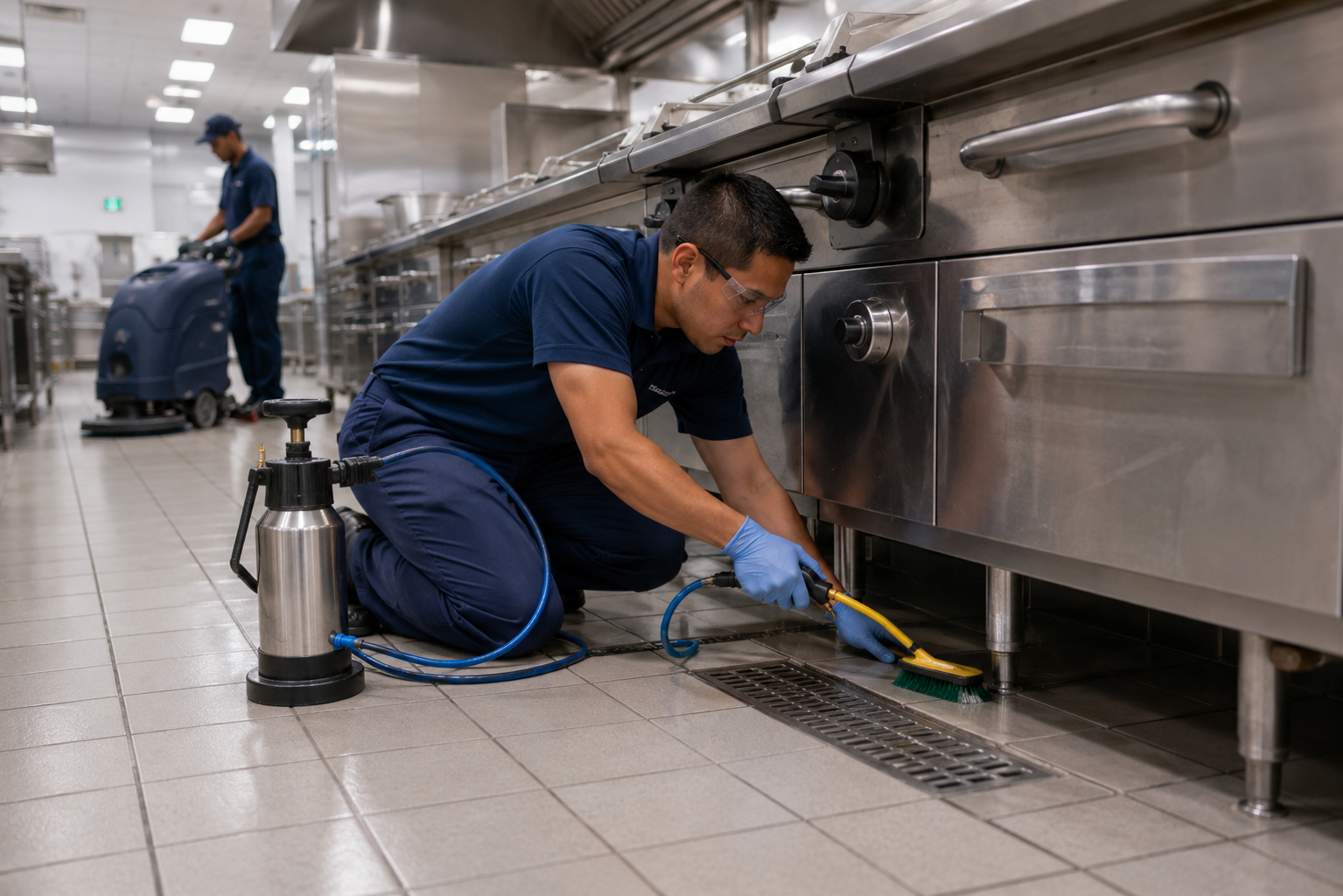
How often does a commercial kitchen need deep cleaning?
A commercial kitchen should receive cleaning every operating day, but there is no responsible universal interval for every deep-cleaning task. High-soil and high-traffic areas may need detailed attention daily or weekly, while accessible equipment perimeters, walls, edges, detailed floor work and other non-food-contact zones may be placed on weekly, monthly, quarterly or project-based cycles. The correct frequency depends on production volume, soil accumulation, surface type, operating hours, access and the facility's food-safety plan.
Food-contact cleaning and sanitation must follow the applicable food code, the operation's approved procedures and equipment requirements. General facility deep cleaning should support that program without being confused with it. Internal exhaust systems, fire-suppression components, grease interceptors and certain equipment may also require separate qualified specialists and independently established schedules.
The question “How often should we deep clean?” usually appears after a visible failure. Grease has migrated beyond the normal closing scope. Edges and casters no longer recover during a routine visit. The waste route creates recurring odor. Detailed floor work keeps being delayed because production releases the kitchen late. These are not simply crew-performance problems. They often show that the frequency, scope and access window no longer match the operation.
The goal is not to choose an impressive-sounding frequency. The goal is to prevent soil from accumulating faster than the facility can safely and consistently remove it. This guide works with Cleanstar National's commercial kitchen cleaning services for high-volume facilities and the commercial kitchen cleaning checklist for large facilities.
Why is there no universal commercial kitchen deep-cleaning schedule?
“Deep cleaning” is an operational phrase, not one standardized regulatory task. One facility may use it to describe machine-supported floor care and detailed work beneath movable equipment. Another may mean a full production shutdown involving food-service staff, facility cleaners, maintenance and specialty contractors. A useful schedule must define the actual zones and tasks instead of relying on the label.
The FDA Food Code provides specific conditions and frequencies for food-contact equipment and utensils. It also states that non-food-contact equipment surfaces should remain free from accumulated dust, dirt, food residue and other debris. Those expectations help establish the required outcome, but they do not turn every large kitchen into the same building with the same soil load or operating window.
Authoritative reference: FDA 2022 Food Code, Chapter 4.
What determines how often a commercial kitchen should be deep cleaned?
Facility managers should evaluate the following factors by zone. A large hotel may need one frequency for banquet production, another for its employee cafeteria and a third for loading and waste transitions. Treating the entire property as one kitchen hides the conditions that actually drive labor and risk.
Production volume and menu
High-throughput cooking, frying, baking and bulk preparation create different residues and accumulation rates. Volume peaks, event schedules and seasonal production can make a fixed annual calendar obsolete.
Operating hours
A kitchen with a short overnight release can complete fewer detailed tasks per visit than one with planned shutdown windows. Frequency must reflect both cleaning need and the time genuinely available to perform the work.
Surface and equipment configuration
Grout, textured flooring, casters, fixed equipment, tight wall clearances and complex transitions can retain soil differently. Equipment movement and utility restrictions also determine which areas are accessible.
Traffic and waste flow
Receiving, service, dish return, waste and employee routes carry soil across departmental boundaries. The schedule should follow these routes instead of stopping at the kitchen doorway.
Internal standards and local requirements
The facility's food-safety program, inspection expectations, brand standards, equipment instructions and requirements adopted by the local jurisdiction all shape the final schedule.
Observed inspection results
Recurring soil at the same edge, drain perimeter, caster or transition indicates that the present task, method, access or interval is inadequate. Inspection data should be allowed to change the calendar.

Commercial kitchen cleaning frequency matrix
Use this matrix as a planning framework—not as a substitute for the facility's food-safety procedures, local requirements, product labels or equipment instructions. During a walkthrough, assign every task to a responsible team and confirm whether it is triggered by time, use, visible condition, production change or a scheduled shutdown.
| Planning interval | Typical operating focus | Management question | Verification approach |
|---|---|---|---|
| During each shift or as conditions require | Food-contact procedures, active spills, waste, immediate hazards and contamination events | Which trained operational team owns the response? | Shift records, manager checks and exception reporting |
| Daily closing or release window | Released floors, accessible equipment exteriors, service areas, dining zones, restrooms and waste stations | When is each zone released, and what remains production-controlled? | Task completion record and supervisor inspection |
| Weekly or rotating detail cycle | Edges, casters, walls, baseboards, accessible under-equipment areas and selected detailed floor work | Who moves equipment and authorizes safe access? | Zone rotation record and defined inspection points |
| Monthly or quarterly planning cycle | Broader deep-cleaning zones, floor restoration, high-detail work and accumulated-condition resets | Does the task need extra labor, shutdown time or specialist support? | Pre/post condition review and corrective-action closeout |
| Event, season or shutdown-based | Renovation recovery, commissioning, seasonal resets, major events or changes in production | What baseline must be restored before operations resume? | Joint walkthrough, documented acceptance and handoff |
“Clean weekly” does not define an executable program. The schedule should state the day, release time, available duration, responsible team, movement restrictions, approved method and inspection requirement. Otherwise, a task can remain technically scheduled while being operationally impossible.
What are the signs that deep cleaning is not frequent enough?
Do not wait for a major failure before adjusting the plan. These patterns indicate that the current frequency, method or service window may no longer match actual conditions.
Soil returns before the next scheduled cycle
If the same edges, grout lines, casters or equipment perimeters fail inspection well before the next service, shorten the interval or redistribute the task across a rotating detail schedule.
Routine crews cannot recover the baseline
Daily maintenance should preserve an agreed condition, not repeatedly perform a full reset. If normal labor is consumed by accumulated conditions, separate the initial reset from the maintainable recurring scope.
Access blocks repeat in the same zones
Late production, stored materials or immovable equipment can make a good calendar fail. Repeated access exceptions require an operating change, not another reminder to the cleaning team.
Odor, residue or pest evidence recurs
Recurring conditions should be escalated and investigated. Cleaning may be one part of the response, but leaks, damaged surfaces, waste handling or pest-control needs may also require facility or specialist action.
- Inspection notes repeatedly identify the same location.
- Closing crews spend increasing time on tasks outside the daily scope.
- Detailed work is consistently canceled for lack of shutdown time.
- Floor finish, grout or other assets deteriorate faster than planned.
- Different departments disagree about who owns the affected zone.
Food-contact sanitation and facility deep cleaning are different programs
Food-contact surfaces and utensils require controlled cleaning and sanitation procedures tied to food use, contamination events and the applicable food code. Facility deep cleaning addresses the broader operating environment: floors, accessible walls, non-food-contact equipment exteriors, service corridors, dining areas, waste transitions and other agreed zones. The two programs must coordinate, but they should not be blended into one vague task description.
FDA research found that a complete wash-rinse-sanitize-air-dry process was effective at removing allergens and minimizing allergen transfer in the conditions studied. It also found that surface material, texture, the type and amount of allergen and wipe condition affected results. That evidence reinforces why food-contact work should follow defined procedures rather than a generic “wipe-down” frequency.
Source: FDA research on allergen removal and cleaning methods.
Chemical controls belong in both programs. OSHA's Hazard Communication Standard addresses written workplace programs, labels, safety data sheets, information and employee training for hazardous chemicals. When food-service employees, facility staff and a cleaning contractor share a workplace, the site should define product approval, SDS access, labeling practices and communication for non-routine work before the deep-cleaning window begins.
How should facility managers build a deep-cleaning schedule?
1. Define the baseline condition
Photograph or otherwise document representative conditions before recurring service begins. Separate legacy buildup from the condition that normal service is expected to maintain. If a reset is necessary, complete and approve it before measuring the recurring schedule.
2. Divide the operation into manageable zones
Map production, preparation, warewashing, service, dining, restrooms, storage, corridors, receiving, loading and waste routes. Large facilities often need different frequencies for each zone. A rotating detail cycle can distribute intensive work without shutting down the entire operation at once.
3. Assign one owner to every task
Label each task as food-service-owned, facility-owned, cleaning-partner-owned or specialist-owned. Identify who releases the zone, who moves equipment, who controls utilities and who accepts the completed work. Clear ownership prevents duplicated work and dangerous assumptions.
4. Match labor to the actual window
Estimate the work that can be completed after production, closing sanitation, deliveries and security procedures are finished. If the remaining window is too short, increase staffing, rotate zones, schedule a shutdown or reduce the scope to an honest executable plan.
5. Pilot, inspect and revise
Run the schedule under normal operating conditions. Record start times, access delays, blocked tasks, inspection results and corrective actions. Revise the interval when evidence shows soil is accumulating faster than expected or the facility consistently prevents access.
Facilities with continuous public traffic may pair scheduled kitchen work with commercial day porter services. Facilities with broad production, warehouse or loading areas may need an integrated industrial and warehouse cleaning program.
How should deep-cleaning frequency be documented and verified?
The operating document should connect each zone to a task, frequency, method, responsible team, access requirement and acceptance standard. A calendar alone is not enough. When a task is blocked, the record should identify why it was not completed, who was notified and when it will be recovered.
- Zone map: defines boundaries and departmental handoffs.
- Frequency matrix: shows daily, rotating, periodic and project-based tasks.
- Product controls: identifies approved products, restrictions and SDS access.
- Access plan: documents release times, security and movement responsibility.
- Inspection standard: names the locations and conditions used for acceptance.
- Exception process: records blocked work, damage, leaks and specialist needs.
- Corrective action: assigns ownership and confirms closeout.
The most useful performance review looks for patterns rather than isolated misses. If a zone repeatedly fails, determine whether the cause is frequency, method, labor, equipment, production access or a facility defect. A schedule becomes an operating system when its data changes decisions.
Related Cleanstar kitchen-cleaning resources
Commercial kitchen deep-cleaning frequency FAQs
Should a commercial kitchen be deep cleaned every day?
Commercial kitchens require cleaning every operating day, but not every intensive detail task must occur daily. Food-contact work follows controlled food-safety procedures, while broader deep-cleaning tasks can be assigned to daily, rotating weekly, monthly, quarterly or project-based cycles according to actual conditions.
Is monthly deep cleaning enough for a large kitchen?
A monthly cycle may be appropriate for selected tasks, but it should not be applied to the whole facility without assessment. Production volume, soil load, access, surface type, daily maintenance and inspection results determine whether a task needs a shorter or longer interval.
Who should determine the cleaning frequency?
Facility management and food-service leadership should establish the schedule with input from the cleaning provider and appropriate specialists. The final program must align with applicable food codes, internal food-safety procedures, equipment instructions, product labels and local requirements.
Are exhaust hoods and ducts part of general kitchen deep cleaning?
Internal exhaust systems, ducts and fire-suppression components should not be assumed to be part of a general facility-cleaning scope. They may require qualified specialty providers and separately established inspection and service schedules. State the boundary explicitly in the contract.
How long does commercial kitchen deep cleaning take?
Duration depends on the number of zones, current condition, equipment access, surface types, soil load, required methods, staffing and shutdown restrictions. A walkthrough is necessary to build a realistic labor plan and confirm what can be completed during the available window.
Can a kitchen remain open during deep cleaning?
Some separated, non-production zones may be serviced while other areas operate, but the plan must control access, chemicals, tools, traffic and food exposure. Intensive work is often best performed after a zone is formally released or during a planned shutdown.
What should be included in a deep-cleaning proposal?
The proposal should identify included zones, tasks, frequency, responsible parties, equipment-movement rules, approved methods, access windows, exclusions, inspection standards, exception reporting and corrective-action procedures. Specialty work should be clearly included, excluded or separately quoted.