Commercial kitchen cleaning and hood cleaning support the same operation, but they do not cover the same systems. This guide shows facility leaders where each service begins, where it stops and how to prevent dangerous gaps or duplicate charges between vendors.
What is the difference between commercial kitchen cleaning and hood cleaning?
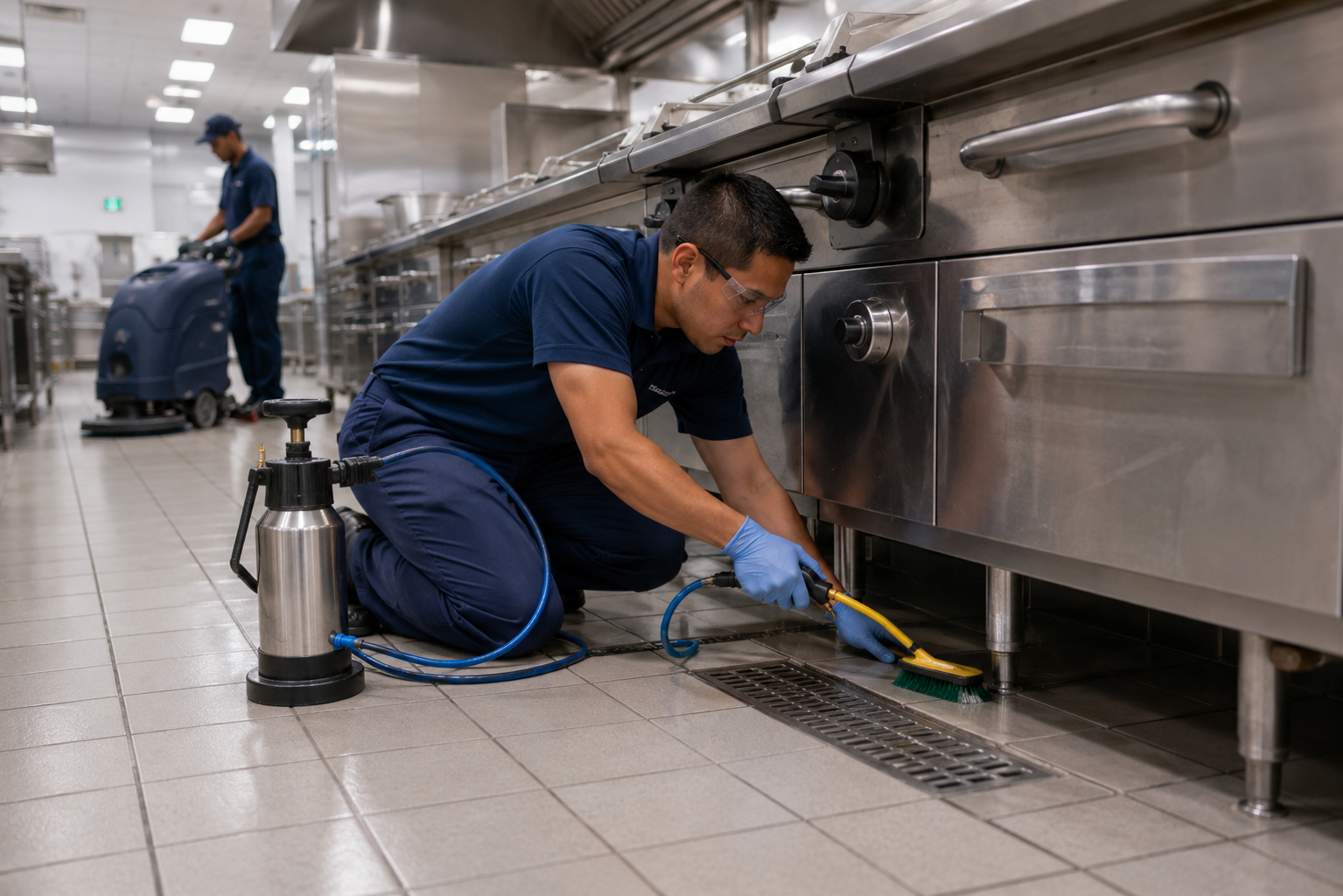
Commercial kitchen cleaning generally addresses the broader facility: floors, walls, baseboards, non-food-contact equipment exteriors, storage and receiving areas, waste staging, walk-ins when included, and scheduled detail cleaning around production. Hood cleaning addresses the grease-laden vapor exhaust system and may include defined portions of the hood, filters, plenum, ductwork and fan under a separately qualified scope.
Neither service should be assumed to include the other. Food-contact cleaning and sanitizing, fire-suppression inspection, grease-trap service, equipment repair and internal appliance work are additional responsibilities that also require explicit assignment. The safest procurement approach is a written responsibility matrix naming the owner, method, frequency and acceptance standard for every kitchen system.
Three cleaning systems operate inside one commercial kitchen
A high-volume kitchen is not a single cleaning zone. It is an operating environment with different hazards, surfaces, technical systems and responsible teams. Combining every task under the word “cleaning” makes proposals look simple, but it can obscure training requirements, access restrictions and critical handoffs.
Food-contact cleaning and sanitizing
The facility’s food-safety program should control surfaces and utensils that contact food. It should identify trained personnel, approved products, sequence, concentration or other applicable controls, verification and operational timing. These duties should not pass to a general facility crew by implication.
Facility and production-area cleaning
This program maintains the physical environment surrounding production. It may include floors, walls, non-food-contact surfaces, equipment exteriors, accessible high areas, storage, receiving, support corridors and periodic projects according to a site-specific task-and-frequency schedule.
Ventilation and fire-system service
The exhaust path and associated fire-protection components form a technical system with separate inspection, cleaning, testing and maintenance considerations. Work should follow applicable requirements, the authority having jurisdiction and the approved vendor scope.
The FDA describes its Food Code as a model offered for adoption by jurisdictions. Its equipment provisions distinguish food-contact surfaces from non-food-contact surfaces and address their cleaning. Facilities should confirm the code adopted locally and build their internal program around those requirements. Review the FDA Food Code 2022 as a national model, then verify state and local obligations.
What commercial kitchen cleaning commonly includes
A commercial kitchen cleaning program is defined by its contract, not by a universal list. For large cafeterias, food halls, food courts, hotels, healthcare kitchens, universities and industrial food-service operations, the facility scope may include:
- hard-surface floor cleaning, edges, corners, transitions and accessible areas beneath movable items;
- walls, doors, frames, baseboards, washable partitions and other defined vertical surfaces;
- non-food-contact equipment exteriors and stainless-steel presentation surfaces;
- accessible shelving exteriors, storage areas, dry storage and receiving zones;
- walk-in cooler or freezer interiors when contents, temperature and access are properly controlled;
- waste staging, dock-adjacent support areas and routes connecting production to disposal;
- accessible high dusting and overhead detail that does not enter restricted technical systems;
- periodic floor care, grout recovery or restoration when separately defined;
- dining support, service-line exteriors and back-of-house corridors; and
- documented inspections, corrective-action follow-up and scheduled detail rotations.
The scope should identify whether kitchen employees complete a pre-clean step by removing food, utensils, smallwares and exposed ingredients before the facility crew enters. It should also state which equipment can be moved, who is authorized to disconnect it and who releases each zone back to operations.
Cleaning the visible exterior of a hood canopy is not the same as cleaning the internal exhaust system. A proposal that says “hood exterior” should not be interpreted as including the plenum, duct, fan, fire-suppression components or every removable filter.
What commercial kitchen hood cleaning addresses
Cooking processes can carry grease-laden vapors into a ventilation path that extends beyond the visible canopy. Hood or exhaust-system service focuses on the components named in that technical scope. Depending on the system, access and provider qualifications, this may involve the hood interior, removable filters, plenum, accessible duct sections, exhaust fan and related access panels. The exact boundary must be verified before work begins.
NFPA 96 is the standard titled Standard for Ventilation Control and Fire Protection of Commercial Cooking Operations. Its current public index includes chapters covering exhaust duct systems, air movement, fire-extinguishing equipment, and procedures for use, inspection, testing and maintenance. Facility owners should use the applicable edition adopted in their jurisdiction and coordinate with their authority having jurisdiction and qualified service providers. See the NFPA 96 public standard page.
Do not assign inspection or testing of the fire-suppression system to the general kitchen cleaning crew unless that work is expressly permitted, qualified and contracted. Likewise, appliance repair, electrical work, fan repair, duct modification and code inspection are not created merely because a vendor is cleaning nearby components.
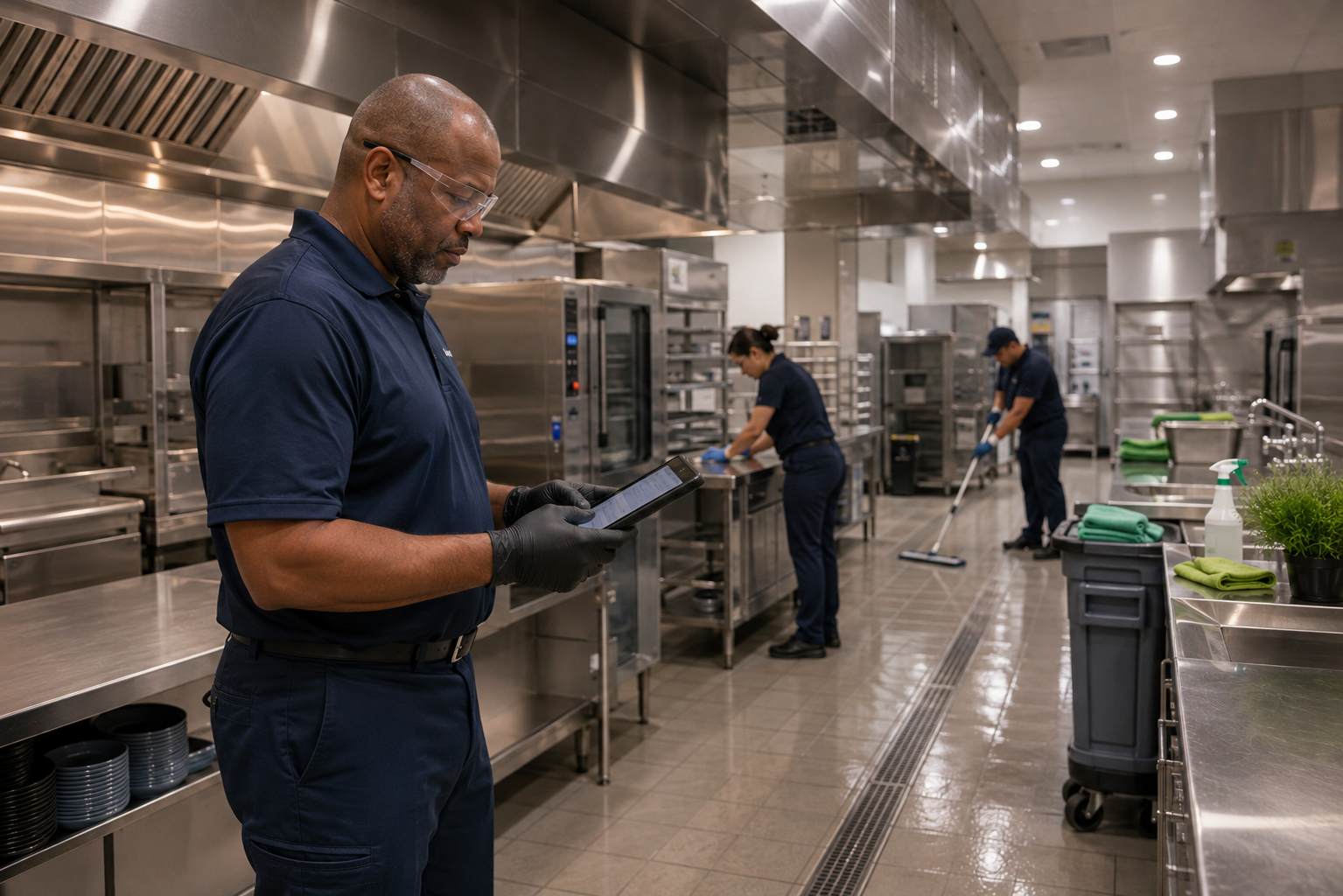
Where kitchen cleaning and hood cleaning scopes overlap
Most contract disputes happen at visible transition points. Each vendor assumes the other owns the task, or both price it without realizing the duplication. Resolve these areas during the walkthrough and photograph the agreed boundaries.
Hood canopy exterior
The facility cleaning team may maintain the visible stainless-steel exterior between specialist services. The contract should define height, sides, underside edges, controls, acceptable finish and any areas excluded because of heat or electrical components.
Filters and filter access
Identify who removes, cleans, replaces and verifies each filter; where the work occurs; and how wastewater, grease and damaged components are handled. “Clean around filters” and “clean filters” are not equivalent tasks.
Backsplash and cook-line exteriors
These areas may be accessible to the kitchen cleaning crew only after equipment is cooled, isolated and released. Define who moves components, protects utilities and confirms that the line is ready to return to service.
Post-service cleanup
Specialist exhaust work can require containment and may affect floors or nearby surfaces. The agreement should state which vendor removes coverings, cleans incidental residue and completes the final room-ready inspection.
Chemical coordination is also part of the handoff. OSHA’s Hazard Communication Standard requires covered employers to address workplace chemical information through a program that includes labels, safety data sheets and employee information and training. Multi-employer workplaces have additional communication considerations. Review 29 CFR 1910.1200 when planning how multiple contractors will work in the same facility.
Commercial kitchen responsibility matrix
The following matrix is a planning tool—not a substitute for applicable requirements or the facility’s contracts. Assign one accountable owner to every row and customize the boundary for the actual kitchen.
| Area or system | Typical lead | Scope question to answer |
|---|---|---|
| Food-contact surfaces and utensils | Kitchen food-safety program | Who cleans, sanitizes, verifies and releases the surface under the facility’s documented procedure? |
| Floors, walls and baseboards | Facility or kitchen cleaning | Which zones, edges, under-equipment areas, methods and frequencies are included? |
| Equipment exteriors | Shared boundary | Which components are cool, isolated, movable and approved for exterior cleaning? |
| Visible hood canopy exterior | Shared boundary | Who maintains it between specialist visits, and where does exterior work stop? |
| Hood interior, plenum, duct and fan | Qualified exhaust-system provider | Which components, access panels, documentation and post-service conditions are contracted? |
| Fire-suppression system | Qualified fire-system provider | Who performs required inspection, testing, maintenance and system restoration? |
| Grease trap or interceptor | Grease-management provider | Who pumps, transports, documents and manages the surrounding cleanup? |
| Equipment repair and utilities | Facility maintenance or trade | Who isolates, repairs, reconnects and confirms safe return to operation? |
How to prevent gaps between cleaning vendors
A coordinated program does not require one vendor to perform every specialty. It requires every vendor to understand the same operating plan. Build the handoffs into the bid package, orientation and service documentation.
- Map the full kitchen. Include production, prep, warewashing, storage, receiving, waste, service lines, walk-ins, ventilation components and support areas.
- Assign one accountable owner. Mark each task as kitchen-performed, facility-cleaning, exhaust-system, fire-system, grease-management, maintenance or excluded.
- Define the physical boundary. Use photographs, equipment identifiers and component names instead of phrases such as “complete hood” or “all kitchen surfaces.”
- Document shutdown and release. Identify cooling, isolation, food removal, equipment movement, access, utility and return-to-service responsibilities.
- Coordinate chemical and safety information. Confirm labels, safety data sheets, storage, ventilation, personal protective equipment and contractor communication procedures.
- Specify evidence of completion. Require appropriate checklists, photos, service reports, deficiencies, corrective action and facility acceptance.
- Control changes. Name who may authorize added work, how it will be priced and how new responsibilities enter the recurring schedule.
Use the companion article on how to write a commercial kitchen cleaning scope of work to turn these boundaries into a bid-ready document. The cost guide explains how to normalize those responsibilities before comparing proposals: How Much Does Commercial Kitchen Cleaning Cost?
How facility type changes the cleaning plan
Responsibility boundaries should reflect how the kitchen actually operates. A single template will not capture every release window, production load or internal control.
Corporate cafeterias and campuses
Predictable meal periods may create useful service windows, but events and occupancy swings can change soil load. Coordinate kitchen service with dining areas, common spaces, loading docks and broader campus schedules.
Hotels and hospitality kitchens
Multiple outlets, banquets, room service and event production can create overlapping schedules. Map each cook line and exhaust system separately, then define which back-of-house team owns shared prep, storage and waste routes.
Food halls and food courts
Tenants may control individual production spaces while property management owns common corridors, waste rooms and some building systems. Lease responsibilities and vendor access should be translated into one operational matrix.
Healthcare, education and institutional dining
Continuous service, controlled access and vulnerable populations may require precise scheduling and documentation. Align facility cleaning with the institution’s approved food, infection-control, safety and contractor procedures.
Industrial kitchens and commissaries
Long production runs, higher throughput and dense equipment can reduce access. Phased releases, planned shutdown work and stronger coordination with maintenance may be necessary to reach all assigned areas.
Multi-site portfolios
Standardize the responsibility categories and reporting format, but allow each site to document its equipment, local requirements, service windows and vendor boundaries. This creates portfolio visibility without pretending every kitchen is identical.
Continue building the commercial kitchen cleaning program
These Cleanstar National resources connect service boundaries to the checklist, frequency, scope and budget decisions required for a high-volume facility.
Commercial kitchen and hood cleaning FAQs
Is hood cleaning included in commercial kitchen cleaning?
Not unless the contract explicitly includes it and the provider is approved for the defined work. General kitchen cleaning commonly covers facility surfaces and equipment exteriors. Internal hood, plenum, duct and fan work is typically handled under a separate exhaust-system scope.
Does cleaning the outside of a hood count as hood cleaning?
No. Maintaining the visible canopy exterior does not demonstrate that internal exhaust components were inspected or cleaned. The contract should distinguish the exterior finish from filters, hood interior, plenum, ductwork, fan and access panels.
Who should clean commercial kitchen exhaust systems?
Facilities should use providers qualified and approved for the contracted exhaust-system work, follow the applicable edition adopted locally and coordinate with the authority having jurisdiction. General facility cleaning credentials alone do not define authorization for technical fire and ventilation systems.
Are food-contact surfaces included in a commercial cleaning contract?
They should never be assumed. The facility’s food-safety program should name the trained team, products, procedures, frequency, verification and release process for food-contact surfaces. A cleaning contract should state the boundary explicitly.
Who cleans commercial kitchen grease traps?
Grease traps and interceptors are normally assigned through a defined grease-management or plumbing-related scope. The responsibility matrix should also identify who cleans the surrounding area and responds if service affects floors or access routes.
Can one company provide kitchen cleaning and hood cleaning?
A company may offer multiple service lines, but each responsibility still needs a written boundary, qualified personnel, applicable documentation and clear acceptance criteria. One company name does not eliminate the need to distinguish the scopes.
What should a commercial kitchen cleaning proposal exclude?
The proposal should clearly identify any excluded food-contact sanitation, internal exhaust components, fire-suppression work, grease-trap service, appliance interiors, equipment repair, utility work, pest control, waste disposal, floor restoration and equipment movement.