

Benchmarking Airborne Particle Risks: Server Room Cleaning
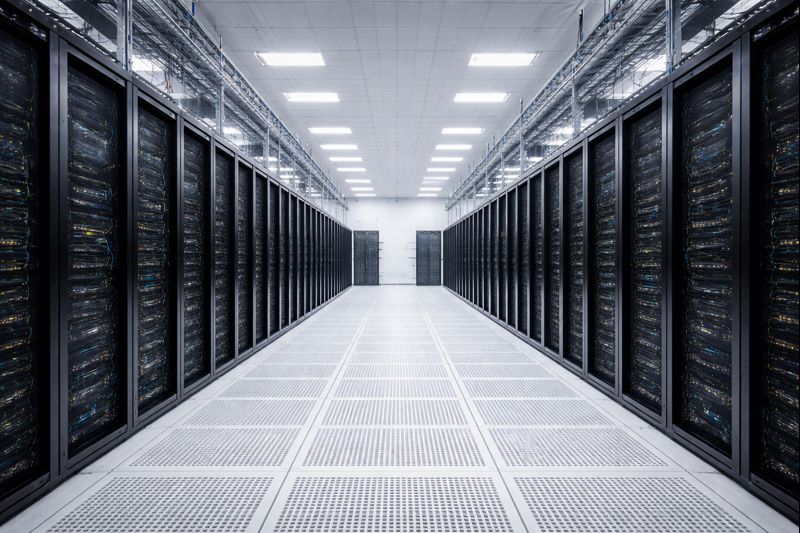
Airborne particles present a measurable risk to uptime, system stability, and compliance in controlled server environments. Industry research has linked particulate contamination to a meaningful share of non-weather-related IT hardware failures, reinforcing the need for structured contamination control within server rooms and data centers.
This requires defined cleaning protocols that address both visible and non-visible contamination sources. Dust accumulation within airflow systems, cable pathways, and equipment surfaces can disrupt cooling efficiency, interfere with sensor accuracy, and contribute to avoidable system interruptions.
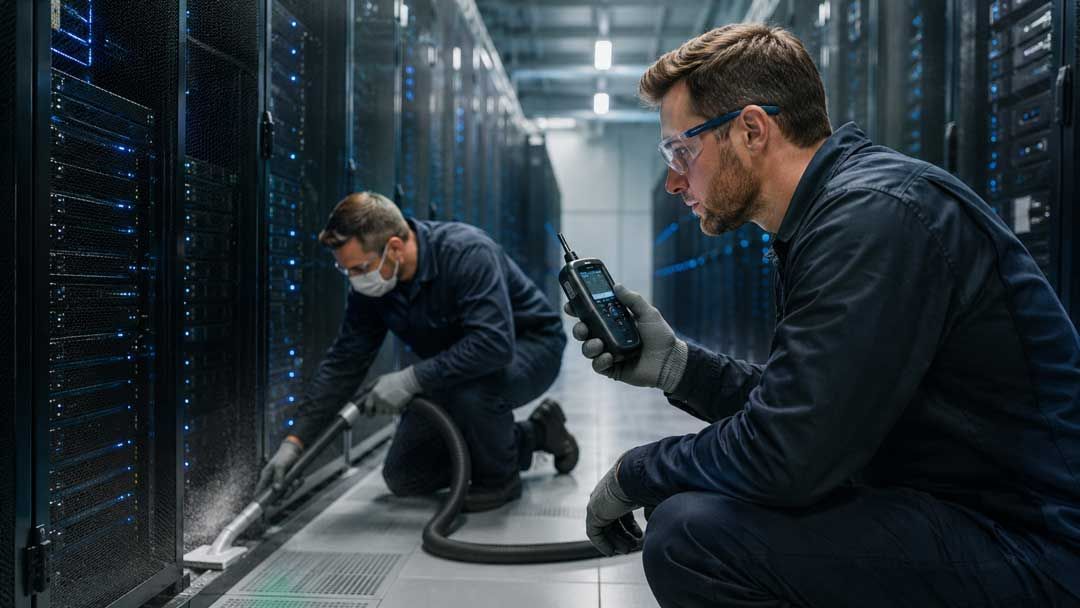
HEPA-filtered cleaning processes play a central role in controlling particulate levels within defined thresholds. When paired with structured monitoring and documentation, these methods support operational continuity across high-density server environments.
Facility design also contributes to airborne particle control. Sealing unfinished concrete surfaces reduces particulate migration into controlled aisles. Ceiling systems introduce additional exposure risk when not maintained, as contamination from overhead zones can enter airflow cycles during maintenance or vibration events.
Advancements in monitoring technology now support continuous air quality tracking through integrated dashboards aligned with Service Level Agreements. These systems provide actionable data for setting cleaning intervals and validating environmental performance based on measurable risk rather than assumptions.
Assess Airborne Particle Levels
Measuring airborne particle levels is a foundational step in maintaining uptime and compliance in server rooms. Within
server room cleaning in Atlanta, this process supports data-driven contamination control and audit readiness across high-performance environments.
Particle Counter Selection: Select calibrated particle counters with a defined particle size range appropriate for controlled environments. Equipment selection should align with industry-recognized standards to ensure reliable data capture.
Sampling Location and Frequency: Position particle counters across multiple zones within the server room, including high-traffic areas, intake pathways, and critical airflow channels. Sampling should occur during both active and idle conditions to identify variation patterns.
Data Recording and Analysis: Record readings digitally to establish a traceable audit trail. Trend analysis enables the identification of recurring contamination sources and supports continuous process improvement.
Comparison with Standards: Benchmark readings against ISO 14644 classifications and ASHRAE guidance. This ensures that environmental conditions align with accepted thresholds and support compliance documentation during audits.
Implement Regular Cleaning Schedules
A structured cleaning schedule is necessary to control airborne particle accumulation in server environments.
Reduction of Particle Accumulation: Scheduled cleaning intervals prevent particulate buildup on surfaces, airflow systems, and equipment enclosures. Early removal reduces downstream contamination risk.
Support for Audit and Compliance Protocols: Documented schedules aligned with ISO 14644 and EPA-aligned practices provide audit-ready evidence of routine contamination control.
Extended Equipment Lifecycle: Consistent cleaning reduces strain on HVAC systems and electronic components, supporting long-term equipment performance and reducing failure exposure.
Utilize HEPA-Filtered Equipment
Cleaning schedules must be supported by equipment capable of capturing fine particulate matter.
HEPA-filtered vacuums and air filtration systems are designed to capture particles as small as 0.3 microns. This level of filtration is necessary in environments where even minimal contamination can affect system performance.
Deploying properly sized HEPA equipment aligned with facility load conditions ensures effective particle removal across all zones. Equipment selection should consider airflow rates, spatial layout, and contamination intensity.
HEPA-based processes also align with ISO 14644 and GMP-aligned expectations for particulate control in controlled environments. These methods support both operational stability and audit readiness.
Seal Concrete Surfaces Effectively
Unsealed concrete surfaces contribute to airborne particulate migration in server rooms. Proper sealing is required to maintain environmental control.
Surface preparation must remove existing dust and contaminants prior to sealant application. Selecting low-VOC sealants reduces chemical off-gassing risks within enclosed environments.
Uniform application and proper curing create a stable barrier against particulate release. Post-application inspections should confirm coverage integrity, as incomplete sealing allows continued contamination.
Routine inspections are required to maintain performance over time, particularly in facilities experiencing high traffic or infrastructure modification.
Address Ceiling Contamination Risks
Ceiling systems represent a persistent contamination source within server environments. Particles originating from ceiling tiles, ductwork, or structural components can enter controlled airflow systems.
Surface Contamination Control: Dust, fibers, and particulate matter accumulate on overhead surfaces and may dislodge during HVAC cycles or facility vibration.
Air Pathway Exposure: Gaps in ceiling systems allow contaminants to enter controlled environments, increasing particulate counts near sensitive equipment.
Maintenance-Driven Risk: Ceiling access during maintenance events introduces contamination if protocols are not followed. Controlled procedures are required to mitigate this exposure.
Structured ceiling inspection and cleaning protocols reduce these risks and support compliance with environmental control standards.
Monitor Air Quality Consistently
Continuous air quality monitoring enables real-time visibility into airborne particle behavior.
Particulate Tracking: Integrated sensor systems provide continuous measurement of particle levels, enabling rapid identification of deviations from baseline conditions.
Standards Alignment: Data should be benchmarked against ISO and ASHRAE thresholds to validate environmental performance and compliance status.
Technology Integration: Modern monitoring systems provide centralized dashboards that support operational decision-making and audit reporting without reliance on manual processes.
Response Protocols: Alert systems should trigger immediate corrective action when thresholds are exceeded, reducing the risk of contamination escalation.
Engage Professional Cleaning Services
Specialized cleaning services are required to manage airborne particle risks in server environments.
Cleanstar National Inc delivers server room cleaning in Atlanta aligned with ISO 14644, EPA, and GMP protocols. The organization operates with a self-performing workforce of more than 700 E-Verified professionals across six states, ensuring consistency, accountability, and compliance across all engagements.
Cleaning execution includes HEPA-filtered equipment, ESD-safe protocols, and structured documentation aligned with enterprise audit requirements. Each service includes pre- and post-cleaning verification processes to support measurable contamination control.
Cleanstar National Inc also supports post-construction cleaning Atlanta projects, where the initial particulate load must be reduced prior to system commissioning. These services are critical in hyperscale builds and newly deployed infrastructure where residual construction dust presents a direct risk to uptime.
As a founder-led organization operating since 1995, Cleanstar integrates certified protocols aligned with OSHA, IICRC, IJCSA, and Red Cross standards. This framework supports high-risk environments such as data centers, healthcare campuses, and advanced manufacturing facilities.
Benchmarking airborne particle risks transforms server room cleaning into a measurable operational control. Particulate monitoring, structured cleaning schedules, and HEPA-based processes collectively reduce contamination exposure across critical infrastructure.
Data-driven environmental management enables facilities to identify risk patterns, validate cleaning performance, and maintain compliance with ISO-aligned standards. Consistent documentation ensures audit readiness and supports long-term operational integrity.
Cleanstar National Inc delivers data center cleaning in Atlanta and server room cleaning services built around risk mitigation, compliance, and uptime protection. Through certified processes, real-time monitoring integration, and self-performing teams, facilities maintain controlled environments that support continuous operation.
In mission-critical environments, airborne particle control is not a maintenance task. It is a core component of operational resilience.
Cleanstar National: Expert B2B Cleaning Solutions for Atlanta's Critical Industries