
Data Center Cleaning Built for Zero Downtime
In data centers, cleanliness is not cosmetic. It is operational. Dust, static discharge, airflow disruption, and particulate contamination create risk long before failure becomes visible.
In mission-critical environments, small oversights compound quietly.
What’s at Risk Inside a Data Center
Data centers are engineered for redundancy, but environmental risk can bypass redundancy entirely. Dust accumulation, underfloor debris, static exposure, and airflow restriction can degrade performance before visible failure occurs.
Primary Risk Vectors
- Underfloor particulate Builds beneath raised floors, around cable trays, and near airflow pathways.
- Thermal imbalance Restricts cooling efficiency and increases stress on critical components.
- ESD exposure Creates static discharge risk around sensitive electronic systems.
- Contamination-driven incidents Can contribute to avoidable service interruptions and maintenance issues.
For a deeper look at how dust affects equipment performance, read How Dust Impacts Data Center Performance and Uptime.
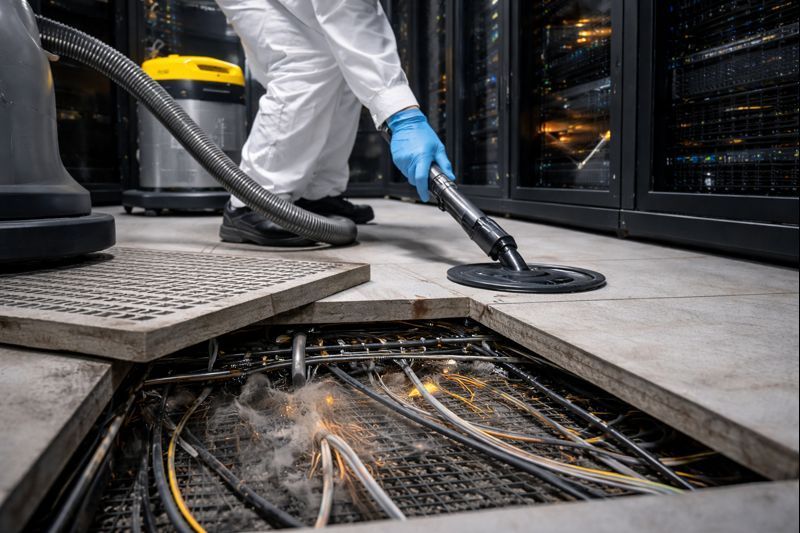
Raised floor contamination and underfloor dust can threaten airflow and uptime long before failure becomes visible.
Why Standard Janitorial Services Fail in Data Centers
Most cleaning providers are not built for mission-critical environments. Standard janitorial methods may be appropriate for general commercial spaces, but data centers require tighter procedures, cleaner tools, and stronger risk controls.
Standard Janitorial
- Non-HEPA vacuums can redistribute fine particulate.
- Limited ESD controls increase static discharge risk.
- General-purpose chemicals may be unsuitable near sensitive equipment.
- Minimal documentation weakens repeatability and audit readiness.
Mission-Critical Cleaning
- HEPA filtration supports fine particulate control.
- ESD-safe tools, apparel, and procedures reduce static risk.
- Equipment-safe methods protect sensitive infrastructure.
- Documented SOPs create repeatable, auditable processes.
Learn more about particulate control in HEPA vs Standard Vacuuming for Atlanta Server Room Cleaning.
In data centers, cleaning must function as part of the operational system, not an afterthought.
The Cleanstar National Approach
Cleanstar National delivers data center cleaning as a risk mitigation discipline. Every procedure is designed to support uptime protection, equipment integrity, and critical environment control.
Systems and Controls
- HEPA-filtered vacuum systems
- ESD-safe equipment, apparel, and procedures
- Raised floor and subfloor contamination control
- Airflow-aware cleaning protocols
- Documented standard operating procedures
- Scheduling aligned to operational windows
Precision is enforced through process, not assumption.
Read: Mission Critical Cleaning for Atlanta Data Centers and Labs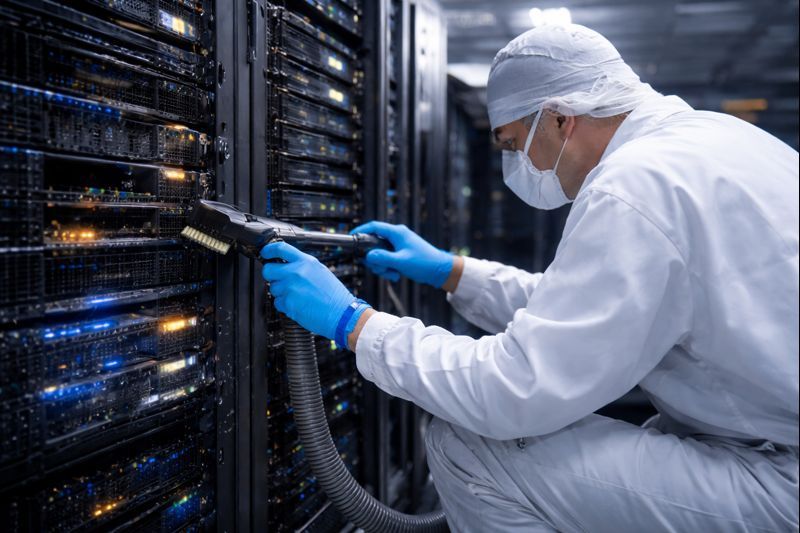
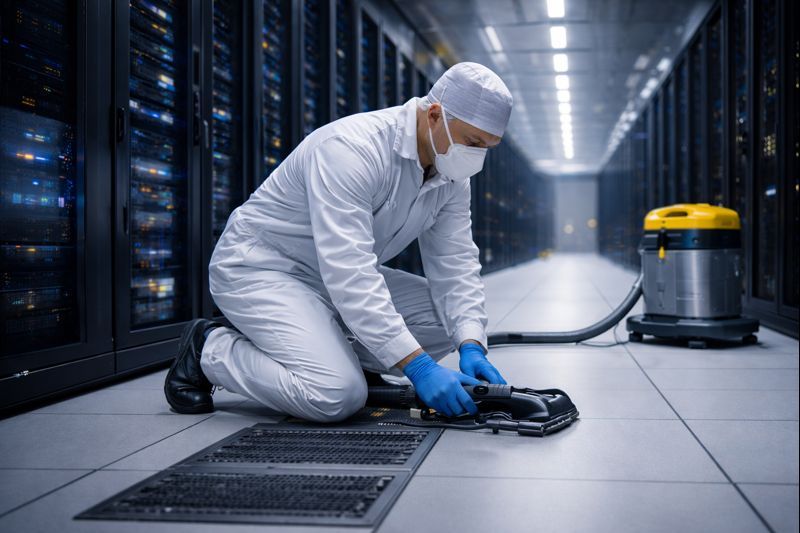
ESD-safe execution with HEPA filtration applied around sensitive server infrastructure.
Where Data Center Cleaning Matters Most
Cleaning schedules and methods must be aligned to access control, equipment sensitivity, live operations, and facility uptime requirements.
If your facility is preparing for turnover or commissioning, review our Post-Construction Cleaning for Atlanta General Contractors.
Supply Discipline Also Matters
Critical environment cleaning depends on the right process and the right materials. For janitorial supply support, cleaning chemicals, restroom products, floor care tools, odor control, and facility maintenance products, Cleanstar National’s supply-side partner, Globe Chemical Company, supports commercial facilities across the Atlanta metro.
For general workplace safety guidance, facility leaders may also review resources from OSHA.
When Downtime Is Not an Option
If your facility cannot tolerate disruption, your cleaning program must be engineered with the same discipline as your infrastructure.
Assessments are planned to avoid disruption to live environments.